

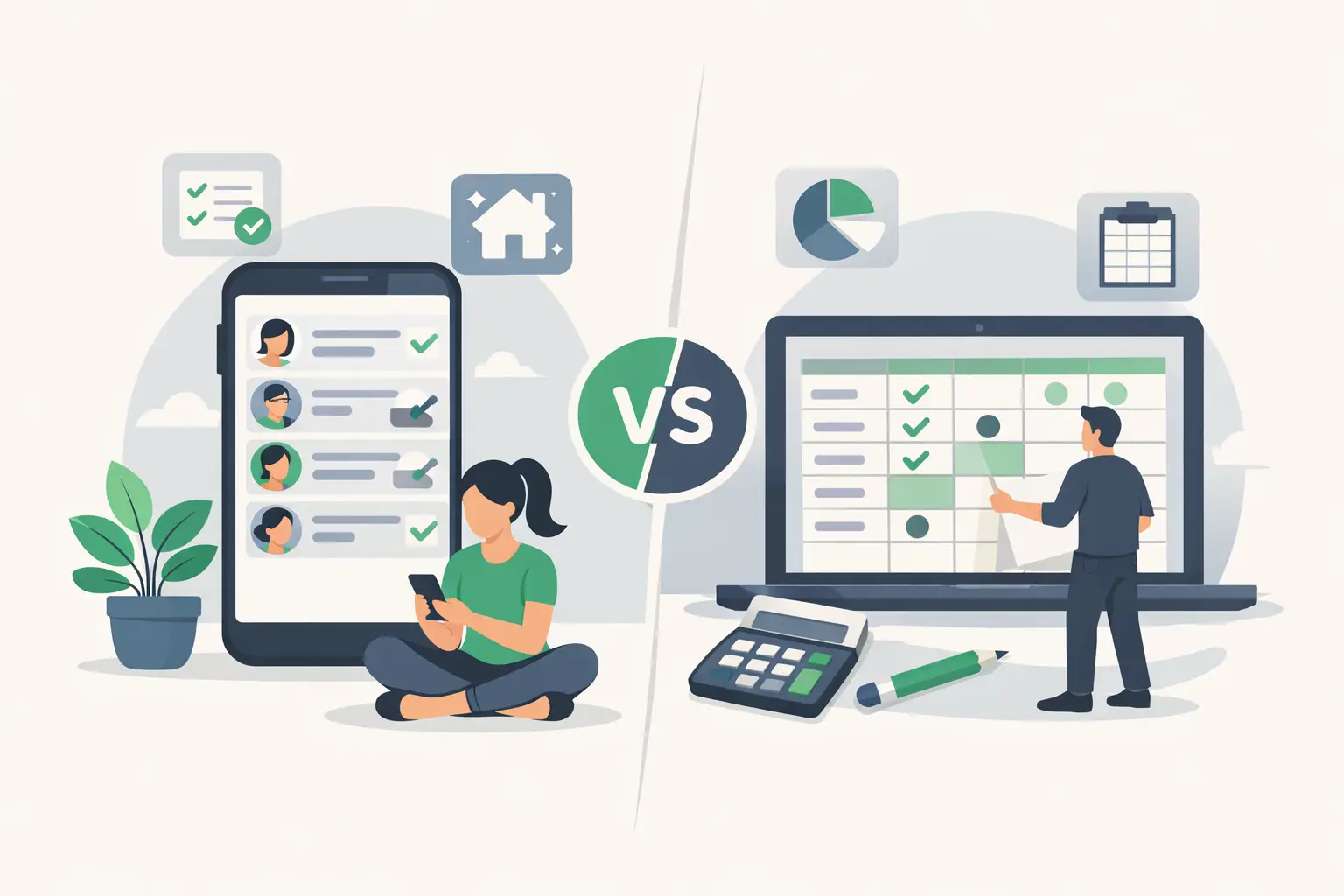
The sink is full, the trash is still sitting by the door, and somehow everyone believes they did their part. That is where the real chore app vs spreadsheet debate starts - not with features, but with friction. When shared work is unclear, resentment fills the gap.
A spreadsheet can absolutely track chores. For some groups, it is enough. But if your real problem is missed follow-through, uneven workloads, or the same person becoming the default reminder system, a spreadsheet often records the mess without fixing it. A chore app is built for the part that hurts most: getting shared responsibilities done fairly and consistently.
Chore app vs spreadsheet: the real difference
On paper, both tools can list tasks, assign names, and show due dates. That is why spreadsheets remain tempting. They are familiar, cheap, and flexible. You can build one in an hour and feel organized by dinner.
But flexibility cuts both ways. A spreadsheet is a blank system. It does not know which chores repeat, who did the harder jobs last week, or whether one person is quietly carrying the load. It relies on someone to update it, check it, chase people, and interpret what is fair. In many homes and small teams, that someone becomes the unpaid operations manager.
A chore app starts from a different assumption: shared labor needs structure. Instead of just storing information, it helps coordinate recurring work, remind people at the right time, and make contributions visible. That difference matters when the issue is not planning chores once, but sustaining them over time.
Where spreadsheets still make sense
Spreadsheets are not useless. They work best when your group is small, your routines are stable, and everyone is already highly accountable. If two organized roommates split a short list of chores and both reliably check the sheet, there may be no reason to add another tool.
They also work for early experimentation. If you are still figuring out what needs to be done each week, a spreadsheet can help you map the work before you formalize it. It is low pressure and easy to edit.
The trouble starts when the system depends on memory, manual updates, or social diplomacy. A spreadsheet does not send a nudge before the café opens. It does not rebalance tasks when one family member handled the deep cleaning twice in a row. It does not show, at a glance, whether the visible jobs and the invisible jobs are falling on the same person.
That is where spreadsheets stop being simple and start becoming fragile.
Why chore apps solve a different problem
A chore app is not just a prettier checklist. At its best, it handles the ongoing mechanics that usually create conflict.
Recurring assignments are a big part of that. Shared spaces run on work that never really ends - dishes, restroom checks, supply restocking, sweeping, closing duties, laundry, trash. In a spreadsheet, those responsibilities often need to be copied, re-entered, or manually marked each cycle. In an app, they can repeat automatically, which removes admin work and reduces the odds that tasks disappear between weeks.
Reminders matter too. Most chore conflicts are not about whether a task exists. They are about whether it gets done before someone else notices and gets annoyed. Timely reminders shift the burden away from one person having to ask, again, and again. That change sounds small, but emotionally it is huge. Resentment loses its hiding place when expectations are visible and follow-through is tracked.
Then there is fairness. This is the point most spreadsheets miss.
Not all chores are equal. Taking out the trash once is not the same as managing dishes every day. Restocking a break room is not the same as doing an end-of-night reset after everyone leaves. A basic spreadsheet can mark both as tasks, but it usually treats them as identical unless someone manually builds a weighting system and maintains it. Most groups never do.
A fairness-focused chore app can assign value based on effort, rotate responsibilities, and show who is contributing over time. That is the leap from task tracking to conflict prevention.
The hidden cost of using a spreadsheet
The most expensive part of a spreadsheet is rarely money. It is the human effort required to keep it useful.
Someone has to build it. Someone has to explain it. Someone has to remind people to check it. Someone has to notice when the schedule no longer reflects reality. Someone has to compare contributions when one person says, "I always do more," and another says, "No you don't."
That manual layer creates a familiar pattern in homes and shared workplaces. The person who cares most about cleanliness or consistency ends up managing the system. They are not only doing tasks. They are carrying the mental load of making sure tasks happen.
This is why a spreadsheet can look efficient while still feeling unfair. It can document work without distributing responsibility for the coordination itself.
Chore app vs spreadsheet for households
In households, emotions move faster than operations. A missed task is rarely just a missed task. It quickly becomes proof that someone is not paying attention, not noticing the mess, or not valuing the other person's time.
A spreadsheet can help if everyone is already aligned and willing to self-manage. But households often need more than a shared list. They need visibility without constant negotiation. Couples need a way to stop relitigating who did what last month. Families need a system that makes expectations clear without turning one parent into the reminder engine. Roommates need a neutral source of truth when standards differ.
That is where a chore app tends to win. It reduces ambiguity, automates repetition, and makes contributions easier to see. The less your system relies on memory and emotional labor, the more peace you protect.
Chore app vs spreadsheet for cafés and small teams
In small businesses and community spaces, the stakes are slightly different but the pattern is the same. If opening duties, cleaning checks, stock refills, or closing routines are not clearly assigned and completed, service quality slips. Then one reliable person compensates. Then burnout shows up.
A spreadsheet can work in very small, disciplined teams, especially when tasks are simple and turnover is low. But once you have changing shifts, recurring operational work, or multiple people sharing the same environment, you need more than a static document.
A chore app gives managers and team members live clarity. What needs doing, who owns it, what repeats, and where things are falling behind become visible without a long meeting or a passive-aggressive message in the group chat. If fairness tracking is included, it also helps prevent the common problem where the same dependable employee gets every unpleasant task because they are the least likely to complain.
How to choose between them
If you are deciding between a spreadsheet and an app, ask a harder question than "Which one is cheaper?" Ask where your current system breaks.
If your group already follows through, tasks rarely change, and no one feels overburdened, a spreadsheet may be fine. Keep it simple. You do not need extra software just to feel modern.
But if your shared space has recurring tension, unclear ownership, inconsistent completion, or arguments about who does more, you are not dealing with a formatting problem. You are dealing with a coordination and fairness problem. That is what a chore app is built to solve.
A good test is this: if your system still depends on one person remembering everything, checking everything, and chasing everyone, it is not really a shared system.
What better looks like
Better does not mean more complicated. Better means the work is visible, expectations are clear, and nobody has to become the household manager or shift cop just to keep the place functioning.
That is why fairness-first tools stand apart from generic to-do apps and spreadsheets. They do not just ask, "Was the task completed?" They ask, "Is the work being shared in a way people can trust?"
For groups that want less tension and more accountability, that distinction matters. Nudge is built around that exact gap - not just organizing recurring chores, but making contribution measurable so imbalance cannot keep pretending to be normal.
If your spreadsheet is keeping the peace, keep using it. But if it is quietly keeping score while one person carries the load, you do not need a better grid. You need a system that makes fairness visible before frustration becomes the loudest person in the room.