

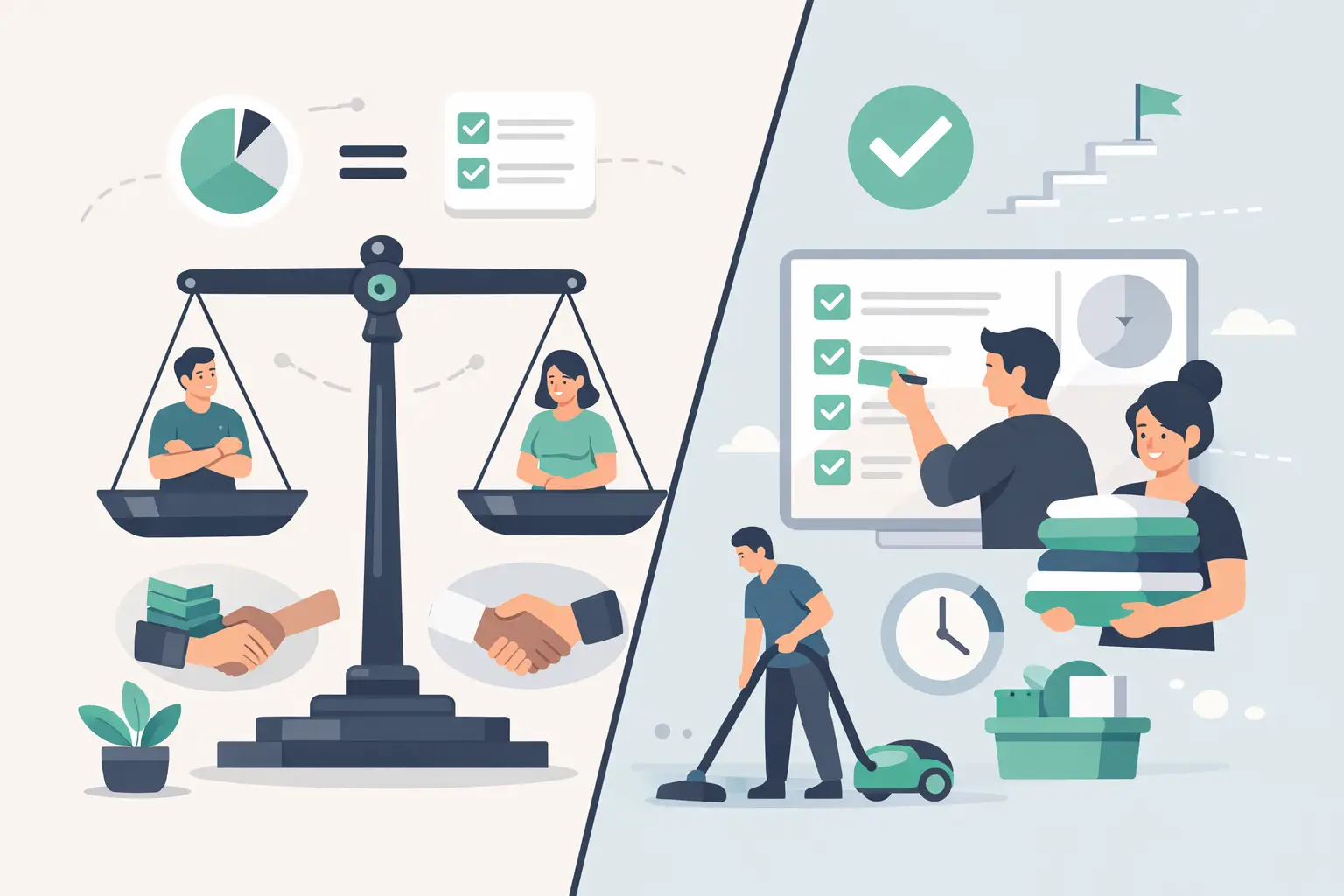
A sink gets emptied. The floor gets swept. The supply closet gets restocked. On paper, everything looks fine. But if the same person keeps noticing, planning, reminding, and picking up the slack, task completion alone tells a very incomplete story. That is the real tension inside fairness tracking vs task completion: one measures whether work got done, while the other shows how the burden of getting it done is actually shared.
For households, cafes, retreat centers, and small teams, that difference matters more than most systems admit. A basic checklist can reduce chaos for a week or two. It does very little for the slow build of resentment that starts when contribution is uneven and invisible. People rarely fight about the existence of tasks. They fight about who carries the mental load, who gets interrupted first, and who is always expected to notice what everyone else missed.
Why fairness tracking vs task completion matters
Task completion is a simple question: was the thing finished? That has value. Shared spaces still need clean bathrooms, stocked paper goods, closed shifts, and trash taken out on time. If nothing is getting done, you do not need a philosophy debate. You need action.
But most shared environments do not break down because nobody made a list. They break down because the same people keep absorbing extra labor that never shows up in the system. That labor includes noticing, coordinating, reminding, checking quality, handling exceptions, and doing the less appealing jobs that others avoid. A completed task log can look balanced while the lived experience feels anything but balanced.
Fairness tracking asks a harder question: who is contributing what over time, and is the load distributed in a way people can actually live with? That shift changes the conversation. It moves teams and households away from defensiveness and toward evidence. Resentment loses its hiding place when contribution is visible.
Task completion is useful, but it has a blind spot
A standard to-do app is designed to answer operational questions. What needs to happen today? Who owns it? Is it done? For one-off projects or personal productivity, that may be enough. In shared living or recurring operations, it often is not.
The blind spot is that not all tasks cost the same. Wiping down a counter is not equivalent to deep-cleaning a bathroom. Locking up takes different energy than managing a messy handoff after a busy shift. Even similar tasks can carry different weight depending on frequency, urgency, and whether they depend on follow-up from other people.
Then there is hidden labor. Someone has to notice the trash is full before the trash can be taken out. Someone has to remember that linens run low every Friday, or that the coffee bar needs restocking before the morning rush, or that guests always arrive right after the common area gets ignored for three days. That person may not complete every visible task, but they are still carrying the system.
A task-completion model tends to reward visible finish lines. A fairness model is better at surfacing the full shape of contribution.
What fairness tracking actually measures
Fairness tracking is not just counting chores. Done well, it looks at workload over time, not just isolated checkmarks on a given day.
That usually means weighting tasks by effort instead of treating all work as equal. It may also mean rotating recurring responsibilities so the same person is not stuck with the most annoying, physically demanding, or mentally draining jobs every week. And it should make imbalance easy to spot before it becomes a fight.
This is where fairness becomes operational instead of emotional guesswork. You are no longer arguing from memory. You are looking at patterns.
In a household, that might reveal one roommate handles fewer tasks overall but consistently takes on heavier cleaning. In a cafe, it might show one employee keeps absorbing opening prep plus side work while others only complete customer-facing tasks that are easier to notice. In a retreat center, it may expose that one coordinator is constantly carrying exception handling, guest resets, and supply issues that never appear in a simple completion report.
Fairness tracking does not eliminate judgment. Some people have different schedules, energy levels, or physical limitations. But it gives you a much better starting point for a fair conversation.
Fairness tracking vs task completion in real life
If you run a shared space, you need both. That is the practical answer.
Task completion protects standards. It makes sure recurring work does not slip through the cracks. You still need to know whether the bathroom was cleaned, the fridge was checked, the tables were reset, or the trash made it out before pickup. Without that visibility, fairness becomes abstract and operations get messy fast.
Fairness tracking protects trust. It shows whether the burden of keeping those standards is landing on the same people again and again. Without that visibility, tasks may technically get done while relationships quietly deteriorate.
This is the part many tools miss. They assume completion equals coordination. It does not. A team can hit every task and still feel unfair. A household can stay functional while one partner is nearing burnout. A roommate group can keep the kitchen clean while one person becomes the unofficial manager of everybody else.
That is why fairness tracking vs task completion is not really a competition. It is a question of what problem you are trying to solve. If the problem is forgotten tasks, completion tracking helps. If the problem is chronic imbalance, completion tracking alone is too shallow.
When task completion is enough
There are cases where fairness tracking may be more than you need.
If responsibilities are already fixed, accepted, and stable, a straightforward checklist can work well. The same is true for very small setups where one person clearly owns operations and nobody expects equal contribution. If a cafe owner assigns all cleaning by shift role and the team agrees the arrangement is fair, completion may be the main metric that matters day to day.
Fairness tracking can also feel excessive if the work is temporary. A short event setup or a one-week guest rotation may not need a long-term fairness view unless tensions are already high.
Still, it is worth being honest here. People often say a simple checklist is enough because it is familiar, not because it is working. If you keep having the same argument about who does more, that is your signal that completion data is missing something important.
When fairness tracking changes everything
Fairness tracking becomes especially valuable in recurring environments where work resets daily or weekly and nobody wants to act like the hall monitor.
That includes couples sharing home upkeep, roommates splitting chores, families managing invisible labor, and small teams handling shared operations. These groups have one thing in common: the real cost is not just missed work. It is emotional drag. It is the low-grade frustration of feeling taken for granted. It is the awkwardness of asking grown adults to do what they already agreed to do.
A fairness-first system lowers that social tax. Instead of one person chasing everyone else, the system makes contribution visible. Instead of arguing over impressions, people can respond to patterns. Instead of assigning the worst jobs to the most responsible person by default, tasks can rotate and effort can be weighted.
That is a big shift. It turns fairness from a personal complaint into a shared operating standard.
What to look for in a fairness-first system
If you are choosing between a generic task manager and a fairness-focused tool, look past the checklist. The key question is whether the system can reflect reality.
Can it handle recurring tasks without constant manual setup? Can it assign different effort values to different kinds of work? Can it rotate responsibilities automatically so the same person is not always stuck with bathrooms, closing duties, or supply runs? Can it show contribution over time, not just today?
It also needs to stay easy. If tracking fairness creates more work than it saves, people will abandon it. The best systems reduce social friction and admin friction at the same time. That is where a platform like Nudge stands apart - it is built not just to record completed tasks, but to show whether shared labor is actually being shared.
The better question to ask your group
Instead of asking, “Did everything get done?” ask, “Is our system fair enough to last?”
That question is more honest. It recognizes that sustainability matters as much as completion. A system that depends on one hyper-responsible person is not efficient. It is fragile. Sooner or later, that person gets tired, angry, or both.
Fairness tracking does not replace accountability. It sharpens it. People still need to follow through. Standards still matter. But when fairness becomes visible, follow-through stops feeling like a personal favor and starts feeling like shared responsibility.
If your current setup tracks tasks but not burden, you may be measuring the neatest part of the problem while missing the part that causes the most damage. The checklist can keep the room running. Fairness is what helps people want to keep sharing it.