

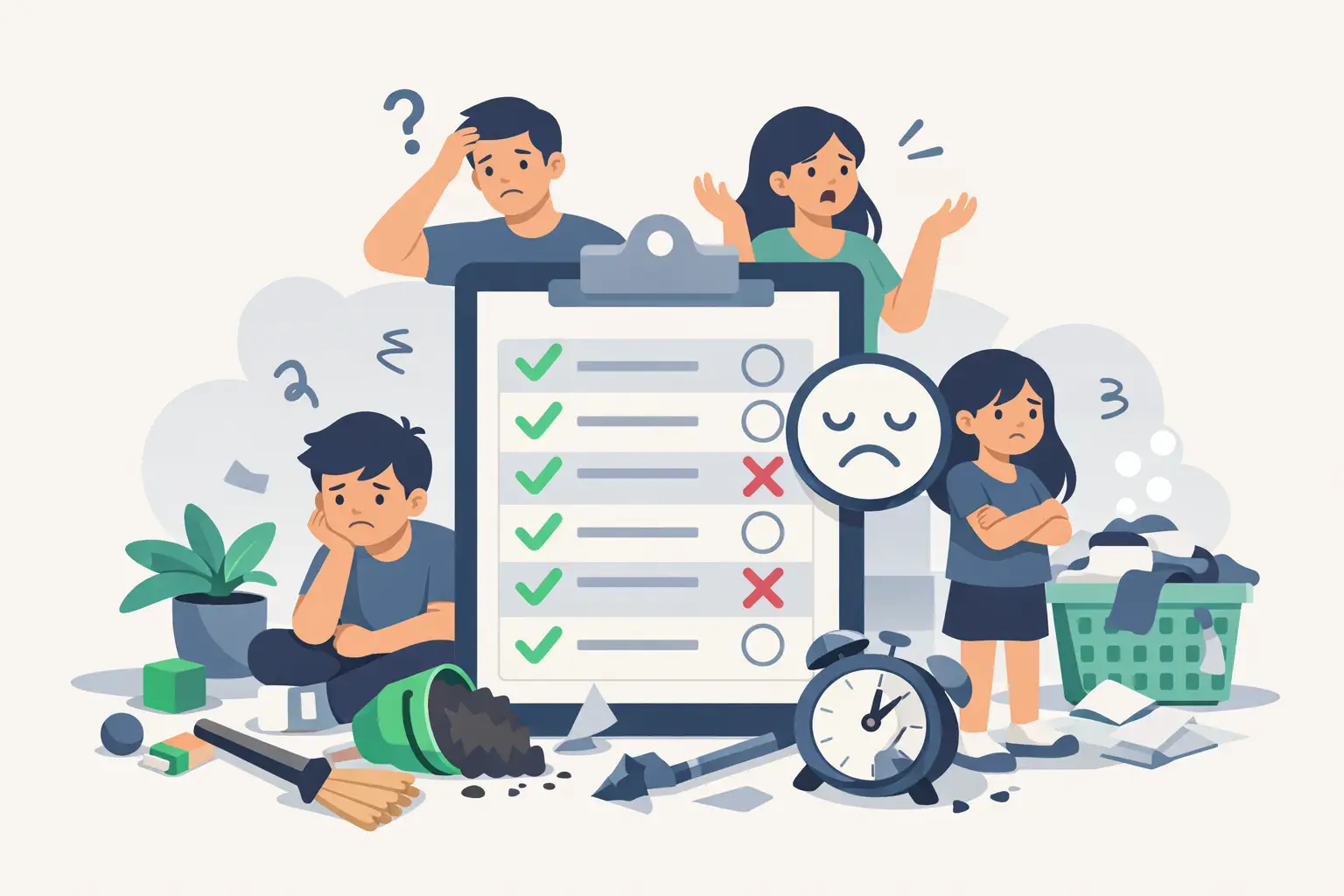
The moment a chore system starts needing one person to remind everyone else, it has already started to fail. That is usually the real answer to why do chore systems fail: not because people do not care, but because the system quietly depends on memory, goodwill, and awkward follow-up. Resentment loses its hiding place fast when one person becomes the unpaid manager of everyone else.
Most shared spaces do not break down because sweeping the floor is hard. They break down because shared labor is emotional, repetitive, and easy to overlook when it is done well. A good system has to handle all three realities at once. If it only tracks tasks, but not fairness, effort, timing, or accountability, it will look organized on paper and still create conflict in real life.
Why do chore systems fail in real life?
Chore systems usually fail because they treat a people problem like a checklist problem. A whiteboard, spreadsheet, or group chat can list tasks, but lists do not resolve tension around who notices messes, who takes initiative, or who keeps covering for everyone else.
That gap matters. In a shared home, the invisible work often includes noticing low supplies, remembering trash day, wiping counters before guests arrive, and following up when someone forgets. In a café or retreat center, it might mean resetting a room, checking bathrooms, refilling basics, or catching missed closing tasks before the next shift. The work is recurring, but the friction comes from uneven ownership.
When people say, "We already tried a chore chart," what they often mean is, "We tried assigning tasks, but the same imbalance came back." The chart did not fail because the idea of structure was wrong. It failed because the structure was too shallow.
The biggest reasons chore systems break down
They confuse assignment with accountability
Assigning a task is not the same as making it likely to happen. A plan that says Jordan cleans the kitchen on Tuesdays sounds clear until Tuesday gets busy, someone assumes it can slide, and nobody knows whether it was done, skipped, or partially finished.
Without visibility, small misses pile up. Then the most responsible person steps in because the sink still needs cleaning or the shift still needs closing. The task gets done, but the system gets weaker. Everyone learns that missed chores do not really stay missed because someone else will absorb the cost.
They ignore the difference between equal and fair
This is where many systems quietly lose trust. Splitting chores evenly sounds reasonable, but not all tasks carry the same weight. Taking out one bag of trash is not the same as deep-cleaning a shared bathroom. Wiping tables during a slow hour is not the same as closing a café after a packed Saturday.
If every task counts the same, the math feels neat while the experience feels unfair. People do not resent doing work. They resent doing more of the draining, time-sensitive, thankless work while being told the split is "equal."
Fair systems account for effort, frequency, and inconvenience. That is what turns a chore plan from polite fiction into something people will actually respect.
They rely on memory and motivation
Most chore systems are built as if people naturally remember recurring responsibilities at the right time, every time. They do not. Life gets noisy. Work shifts change. Kids get sick. Roommates travel. Staff turns over. Good intentions are not a reliable operating system.
A system that depends on people remembering without prompts usually shifts burden onto the person who notices what is missing. That person becomes the reminder engine, and soon after, the frustrated one. This is one of the clearest answers to why do chore systems fail over time: they ask humans to do too much administrative work just to keep basic responsibilities moving.
They make invisible labor even more invisible
Some work is easy to see. A mopped floor looks mopped. Other work disappears the moment it is done. Restocking paper towels, checking supplies, rotating laundry, prepping a common room, or noticing that something needs attention before it becomes a problem - that labor often goes uncounted.
When systems only reward visible, discrete tasks, the people doing maintenance and anticipation get overlooked. Over time, they either burn out or stop doing the extra care work that kept the space functioning smoothly in the first place.
They are too rigid for real schedules
Many systems collapse when real life stops matching the original plan. The person assigned to Saturday bathrooms may pick up extra shifts. The roommate who usually handles dishes may be traveling. The staff member responsible for opening tasks may be covering another location.
A chore system needs structure, but it also needs flexibility. If swapping is messy, reassigning feels personal, or there is no way to rotate recurring work fairly, the plan becomes brittle. Brittle systems do not survive normal disruption.
They create social tension around follow-up
This is the hidden tax of bad systems. When responsibilities are unclear or untracked, every reminder feels personal. "Can you do your part?" starts sounding like "You are unreliable." Even gentle follow-up can feel parental, passive-aggressive, or loaded with history.
That is why so many groups avoid addressing missed chores until the frustration boils over. The issue is not only the task. It is that the system turns ordinary coordination into relationship management.
What a chore system needs to work
A workable system has to do more than assign jobs. It has to reduce ambiguity, show contribution, and prevent one person from carrying the mental load of enforcement.
First, responsibilities need to be visible. People should know what needs doing, when it needs doing, and whether it has been completed. This sounds basic, but it changes the emotional tone immediately. Visibility replaces nagging with shared facts.
Second, the system needs a fairness logic, not just a task list. That means recognizing that chores have different effort levels and that recurring hard jobs should rotate. Otherwise the same people end up handling the least pleasant work because they are faster, more competent, or less willing to let standards slip.
Third, follow-through needs support. Reminders, recurring schedules, and easy reassignment are not extra features. They are what keep a system alive when attention is split.
Fourth, contribution should be measurable over time. One missed task is not the issue. Patterns are the issue. When contribution stays invisible, people argue from feelings and memory. When contribution is tracked, imbalance becomes easier to address early, before resentment becomes the house manager.
Why simple chore charts rarely last
A chore chart can be useful for a week or two because it creates a burst of clarity. Everyone sees the plan, agrees to it, and feels relieved. Then reality arrives. Someone does half a task. Someone swaps informally. Someone takes on extra work without logging it. Someone forgets. Someone notices and compensates.
Soon the chart no longer reflects the actual labor happening in the space. At that point, it stops being a coordination tool and becomes decor.
This does not mean simple tools are always bad. For a small household with strong habits and low complexity, a basic chart may be enough. But once you have recurring friction, uneven standards, rotating schedules, or any history of one person carrying the load, basic tools tend to underperform because they cannot capture the full picture.
A better approach: design for fairness, not just completion
The best chore systems are built around a more honest question. Not "Was every task assigned?" but "Can everyone see that contribution is fair?"
That shift changes everything. It moves the focus away from blame and toward shared operations. It makes it easier to spot when a system looks equal but feels lopsided. It also gives groups a way to talk about labor without turning every conversation into a referendum on character.
This is where fairness-first tools make a real difference. A platform like Nudge works because it does not stop at task creation. It rotates recurring work, weights chores by effort, and makes imbalance visible before it hardens into conflict. That is not just cleaner logistics. It is a calmer shared environment.
If your current system keeps failing, the problem is probably not that your group is bad at chores. The problem is that your system expects trust without proof, effort without visibility, and follow-through without support. People can carry that for a while. They cannot carry it forever.
The fix is not more pressure. It is a system that makes shared labor visible enough, fair enough, and easy enough to sustain when life gets messy.