

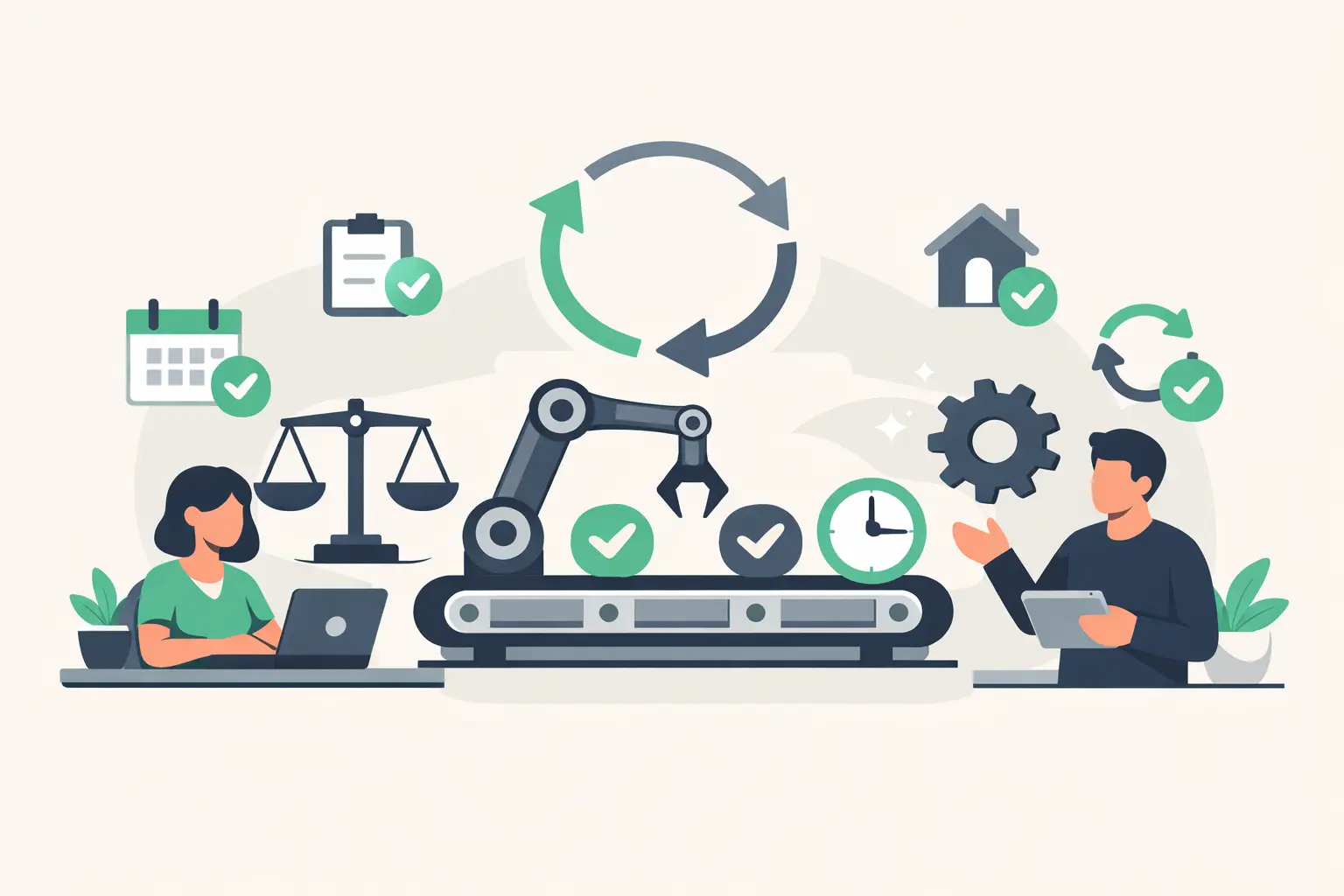
The dishwasher does not care whose turn it is. The bathroom does not remember who cleaned it last. But the people sharing a home, café, retreat center, or small workspace do remember. That is why a guide to recurring task automation has to address more than reminders. The real goal is to make recurring work visible, distribute it fairly, and stop the same few people from carrying the mental load.
A task list can tell everyone that floors need mopping. Automation can make sure the task returns every week, reaches the right person, and rotates before one reliable person becomes the default cleaner. Done well, it replaces vague promises with a system people can see and trust.
Why recurring tasks create so much friction
Recurring work is easy to underestimate because no single task looks especially difficult. Wiping counters takes minutes. Restocking supplies takes minutes. Taking out trash takes minutes. Yet those minutes accumulate, and the planning behind them accumulates faster.
Someone has to notice the soap is gone, remember the trash day, decide who should close the café, follow up when a task is missed, and absorb the consequences when nobody does it. That invisible coordination work often lands on the same person who is already doing more of the physical work.
This is where resentment gets its hiding place. A group may agree that everyone should help, but without a shared record, contribution becomes a debate based on memory. People remember their own effort clearly and everyone else's selectively. Automation cannot make people care, but it can make expectations, assignments, and follow-through harder to ignore.
What recurring task automation should actually do
At its simplest, recurring task automation creates tasks on a schedule. A weekly bathroom clean appears every Sunday. A weekday opening checklist appears each morning. A monthly inventory review returns on the first of the month.
That is useful, but scheduling alone is not enough for a shared space. A better system also answers three questions: Who owns this instance of the task? How much effort does it represent? What happens when it is skipped?
For groups, the strongest setup includes these functions:
- Repeat schedules that match real life, including daily, weekly, monthly, and custom intervals.
- Automatic rotation so responsibility does not stick to the most dependable person.
- Task values that reflect effort, not just task count.
- Clear reminders and completion records that everyone can access.
- A visible view of contribution over time, not just what is due today.
The distinction matters. If emptying a small office bin and deep-cleaning a shared kitchen each count as one task, the system may look equal while the workload is not. Fairness is not identical task counts. It is a reasonable balance of time, difficulty, unpleasantness, and frequency.
A practical guide to recurring task automation
1. Start with the work that causes repeat conflict
Do not automate every tiny action on day one. Start with the responsibilities that recur, affect everyone, and already create tension. For a household, that may include dishes, trash, bathrooms, laundry, grocery basics, pet care, and shared bills. For a café, it may be opening duties, closing duties, food-prep sanitation, stock checks, and waste logs.
Ask one useful question: if this task is missed twice, who notices and who pays for it? That reveals the work worth tracking first.
Keep the first set manageable. Ten well-defined recurring tasks will create more clarity than fifty vague ones. You can add detail after the group sees the system working.
2. Define what “done” means before assigning it
“Clean the kitchen” is not a task. It is an argument waiting to happen.
Specify the expected outcome in a short note. For example, a kitchen reset might mean loading or unloading the dishwasher, wiping counters and the table, putting food away, and taking out trash if it is full. A closing task at a café might include cleaning the espresso station, recording waste, sanitizing surfaces, and locking designated storage.
The right level of detail depends on the group. A couple may need only a sentence. A team with rotating shifts may need a checklist. The point is not to micromanage people. It is to remove the ambiguity that produces passive-aggressive follow-ups later.
3. Set a cadence people can realistically keep
A task should recur based on need, not optimism. If a shared bathroom needs attention twice a week, assigning it monthly guarantees frustration. If a supply check only matters every two weeks, daily reminders train people to dismiss notifications.
Use fixed schedules for predictable work, such as a weekly cleaning day or daily opening routine. Use flexible recurrence when needs vary, such as “every three days after completion” for watering plants or “every 14 days” for restocking supplies.
There is a trade-off here. More frequent tasks make standards easier to maintain, but they can overwhelm a group with alerts. Fewer tasks reduce notification fatigue, but make skipped work more expensive. Adjust the schedule after two or three cycles using what actually happens, not what sounded reasonable in the planning conversation.
4. Rotate responsibility instead of assigning permanent defaults
The fastest route to an unfair system is giving recurring work to the person who is best at noticing it. They may be organized, conscientious, or simply less willing to live with disorder. None of those qualities should make them the permanent operations department.
Rotation spreads both the physical work and the awareness of what shared life requires. It also prevents a common pattern: one person becomes the reminder machine while everyone else waits to be asked.
Not every task needs a simple round-robin. Some jobs require training, access, or a particular shift. In that case, rotate within the people who can reasonably do it, or balance a specialized task with other work of similar weight. Equality does not mean ignoring capability. It means avoiding convenience as an excuse for permanent imbalance.
5. Give effort a value, then look at the pattern
A fairness-first system treats a five-minute reset differently from a forty-minute deep clean. Assign task values based on a mix of time, difficulty, urgency, and how unpleasant the task is. The numbers do not need to be perfect. They need to be agreed upon and consistent enough to reveal patterns.
For example, wiping a shared table after dinner might be one point, taking out bins might be two, cleaning a bathroom might be five, and a full weekly supply run might be six. Over a month, those values show whether work is broadly balanced.
This is where a live Fairness Score can be more useful than a pile of completed checkmarks. Checkmarks tell you that tasks happened. A contribution view tells you whether the same person keeps doing the heavier work. Nudge uses effort-weighted tasks and a live Fairness Score to turn that previously invisible pattern into something a group can address before it becomes personal.
Make reminders useful, not nagging
Automated reminders work best when they are specific, timely, and neutral. “Bathroom clean is due today” is clearer than “Please help more.” The first is an operational prompt. The second is loaded with history.
Choose reminders that fit the task. A morning reminder may work for opening duties. An evening reminder may fit a kitchen reset. A weekly planning reminder can help a household review the coming week before schedules get crowded.
Avoid sending repeated alerts to everyone for one person's task. That creates noise and makes the group feel policed. Send the primary reminder to the assigned person, then use an agreed escalation only when a deadline passes. The goal is accountability, not public embarrassment.
If tasks are frequently skipped, do not just increase reminders. Investigate the cause. Is the task unclear? Is it assigned at a bad time? Is its value too low for the effort involved? Is one person overloaded outside the system? Automation surfaces these questions. The group still has to answer them honestly.
Use the data for conversations, not scorekeeping
Contribution data can lower conflict, but only if it is used with care. A Fairness Score should start a conversation, not end one. Someone may have completed fewer assigned chores because they covered emergency shifts, handled childcare, or took on untracked administrative work.
Set a regular, low-drama review point. For a home, ten minutes once a week may be enough. For a small team, review the previous week during an operations check-in. Look for trends: recurring misses, overloaded members, tasks that need clearer instructions, and work that exists but has not been added to the system.
When the numbers show an imbalance, talk about the process before judging the person. Try: “This task has been overdue three weeks in a row. Is the schedule wrong, or does ownership need to change?” That question is more productive than, “Why do you never do this?”
A fair system also leaves room for temporary adjustments. A new parent, a coworker covering extra shifts, or a roommate in exam season may need a lighter share for a while. Make that change visible and time-bound. Invisible exceptions are how temporary help turns into permanent burden.
Keep the system alive after setup
Recurring task automation is not a one-time configuration project. Shared spaces change. People move in, schedules shift, busy seasons arrive, and standards evolve. Review your task list monthly or whenever the group starts feeling friction again.
Delete tasks nobody uses. Split tasks that are consistently too broad. Change frequencies that do not match reality. Add the invisible labor that people keep mentioning in conversation. A system earns trust when it reflects actual work, not an idealized version of it.
The best recurring task system does not make a household or team feel like a workplace. It makes shared responsibility feel less personal when something goes wrong and more visible when someone shows up. When the work has a name, an owner, a rhythm, and a fair measure, resentment has far less room to grow.