

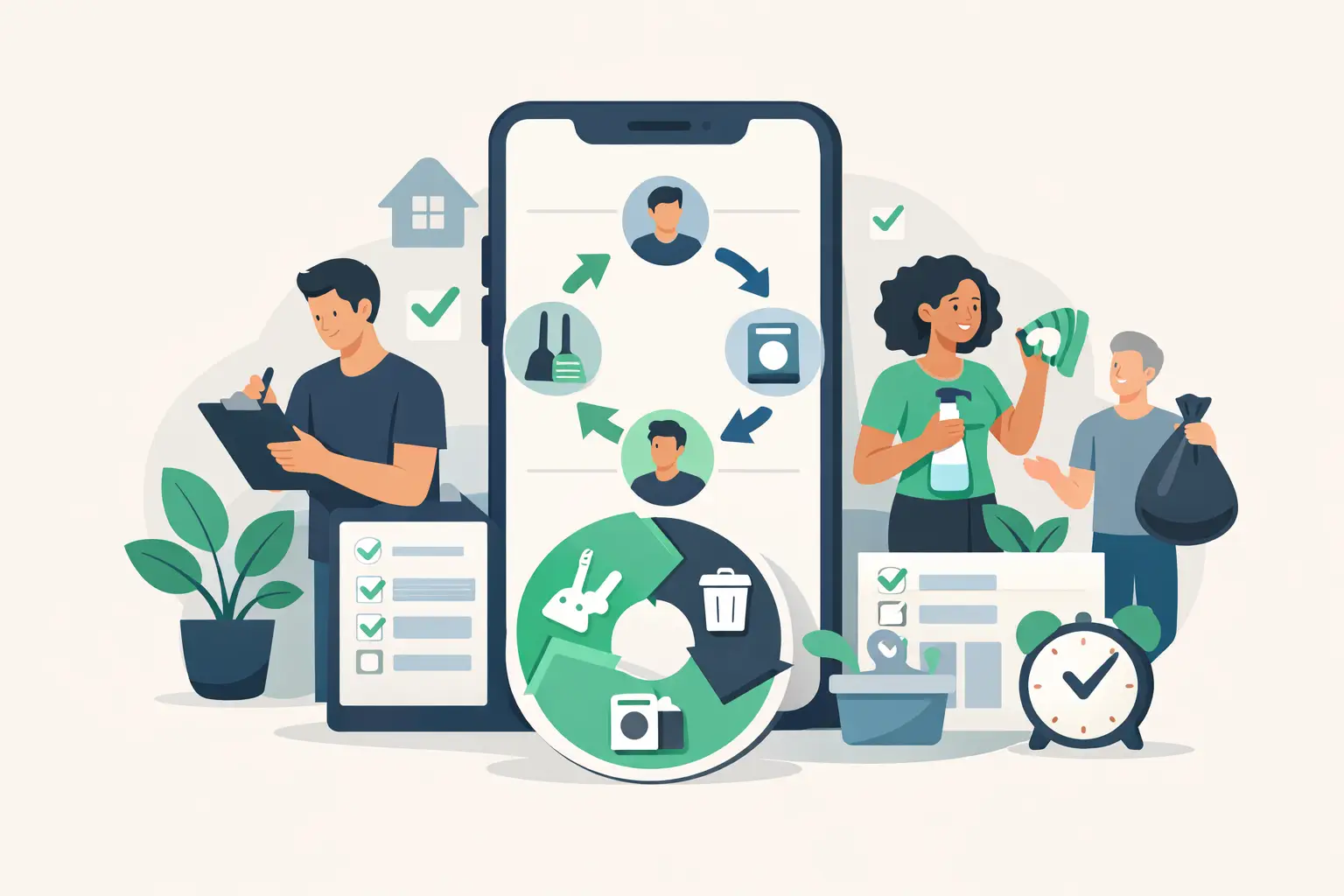
If your current chore system depends on someone remembering, reminding, and quietly resenting everyone else, it is not a system. That is why people start looking for the best app for chore rotation in the first place - not because they need another to-do list, but because they are tired of carrying the mental load.
For shared spaces, the real problem is rarely assigning a task once. It is keeping recurring work visible, rotating it fairly, and making sure no one gets stuck with the gross jobs, the invisible jobs, or the jobs that somehow never count. The best chore rotation app solves that deeper problem. It does not just organize tasks. It removes ambiguity, reduces friction, and gives everyone the same view of what fair actually looks like.
What makes the best app for chore rotation
A lot of apps can repeat a task every Tuesday. That alone does not make them useful for shared labor. The best app for chore rotation needs to handle three things at the same time: recurrence, accountability, and fairness.
Recurrence is the easy part. Trash goes out every week, bathrooms need cleaning, side work needs to be closed, and shared kitchens do not stay clean by accident. A decent app can automate that schedule.
Accountability is harder. If a task gets assigned but nobody notices, follows through, or checks completion, the app becomes a digital version of a sticky note. Reminders matter. So do calendar views, task history, and a clear record of who did what.
Fairness is where most tools fall apart. Not all chores are equal, and people know it. Wiping a counter is not the same as deep-cleaning a fridge. Opening a café is not the same as handling the end-of-day scrub down. If the app treats every task as identical, resentment finds a way back in.
Why generic to-do apps usually fall short
Generic task apps are good at personal productivity. Shared labor is a different beast.
In a household or small team, the tension usually comes from uneven effort, not a lack of task creation. People do not argue because there was no checkbox for "clean the bathroom." They argue because one person notices everything, another person forgets until reminded, and a third thinks taking out the recycling once somehow balances an entire week of maintenance.
Most to-do apps are built around completion, not contribution. They show whether a task was done, but not whether the workload is being shared in a way people recognize as fair. That gap matters.
Spreadsheets have a similar problem. They can track more detail, but they create admin work and almost never hold up in real life. Someone has to maintain the sheet, remember the rotation logic, update the assignments, and chase people down when the system drifts. Before long, the spreadsheet has an owner, and that owner becomes the default manager of everyone else’s responsibilities. That is exactly the role most people are trying to escape.
The features that actually reduce conflict
If you are comparing options, skip the feature pileup and focus on what changes behavior.
Smart rotation, not static assignment
A fixed task list can work for a week or two. Then one person gets stuck with dishes forever, another always handles garbage, and the least pleasant tasks start to feel political. Rotation matters because it spreads burden as well as responsibility.
The strongest apps automate that rotation instead of asking users to manually reshuffle assignments. That is especially useful in groups where schedules shift, people travel, or staff availability changes week to week.
Weighted effort instead of one-task-equals-one-task
This is the feature most people do not know they need until they see it. Equal task counts do not always mean equal effort.
A good system accounts for task weight. That could mean time, intensity, frequency, or how undesirable the task is. Once you track effort instead of raw completions, the conversation changes. People stop arguing over impressions and start reacting to visible patterns.
Clear reminders and follow-through
No one wants to become the chore cop. The best app for chore rotation should send reminders automatically and make ownership obvious. A missed task should be visible without requiring a tense text message or a passive-aggressive note on the fridge.
That visibility matters in homes, but it matters just as much in cafés, studios, retreat houses, and other shared environments where operational sloppiness becomes everyone’s problem fast.
A fairness view everyone can see
This is the difference between a task app and a shared-labor system. When contribution is measurable, resentment loses its hiding place.
A fairness view does not need to shame anyone. It simply needs to show the truth: who has carried more, who has carried less, and where the imbalance is forming. That creates a cleaner conversation because the issue is no longer vague. It is visible.
The right app depends on your shared space
There is no universal winner for every group, because different spaces break in different ways.
For roommates, the biggest issue is usually follow-through. People have different standards, different schedules, and different definitions of "I was going to do it later." Here, simplicity matters. You want fast setup, recurring assignments, reminders, and an easy way to see whether the load is drifting onto one person.
For couples and families, the challenge is often invisible labor. One person may be doing planning, noticing, tracking supplies, and handling the tasks that never make it onto a list. In that case, a basic chore chart can actually make things worse if it only captures obvious tasks. The better app is the one that lets you define recurring work in enough detail to reflect real effort.
For small businesses and shared hospitality spaces, consistency is the issue. The sink still needs to be cleaned, the supplies still need to be checked, and closing tasks still need to happen even when shifts are busy or staff changes. A stronger app here needs templates, team segmentation, repeat schedules, and enough reporting to spot where standards are slipping.
What to look for before you commit
A lot of apps look good in a demo because they show colorful checkmarks and clean interfaces. The better test is to ask what happens after week three.
Does the app still work when someone misses a task? Can you see historical contribution without pulling a report from three places? Can you rotate responsibilities without rebuilding the setup each time? Can the group understand it without training or a manager translating the system for everyone else?
Ease matters. If an app takes too much effort to maintain, the most responsible person will end up doing that maintenance too. Then the tool adds work instead of removing it.
You should also pay attention to emotional usability. That sounds soft, but it is not. Shared labor tools live in emotionally loaded situations. If the app creates confusion, public blame, or constant manual correction, people will stop using it. The best systems feel clear and firm without becoming punitive.
Where fairness-first apps stand out
This is where a platform like Nudge makes a meaningful difference. Instead of treating chores like generic tasks, it is built around recurring shared responsibilities and the question underneath them: is the load actually being shared fairly?
That changes the entire experience. Rotation is automatic. Effort can be weighted. Contribution becomes visible over time through a live Fairness Score rather than vague memory or whoever argues best. For households, that means fewer circular conversations. For small teams, it means less operational drag and less burnout hidden inside "everyone helps out" culture.
That does not mean every group needs advanced analytics on day one. If you live alone, you do not need fairness tracking. If your household is tiny and naturally balanced, a simple checklist might be enough. But once shared work starts creating tension, fairness stops being a nice idea and becomes an operational requirement.
So what is the best app for chore rotation?
The honest answer is that the best app for chore rotation is the one that makes recurring work feel fair, visible, and hard to ignore. For some groups, that may start with basic recurring assignments. For many, especially where resentment is already building, basic is not enough.
If your biggest problem is not creating chores but making sure the same person does not keep absorbing them, choose the tool that tracks contribution, not just completion. Choose the one that can rotate work automatically, reflect different effort levels, and show the group what is happening before frustration turns into a fight.
People do not need more reminders to care. They need a system that stops fairness from being guesswork. Once that happens, the room gets lighter. The work still exists, but it stops dragging your relationships down with it.