

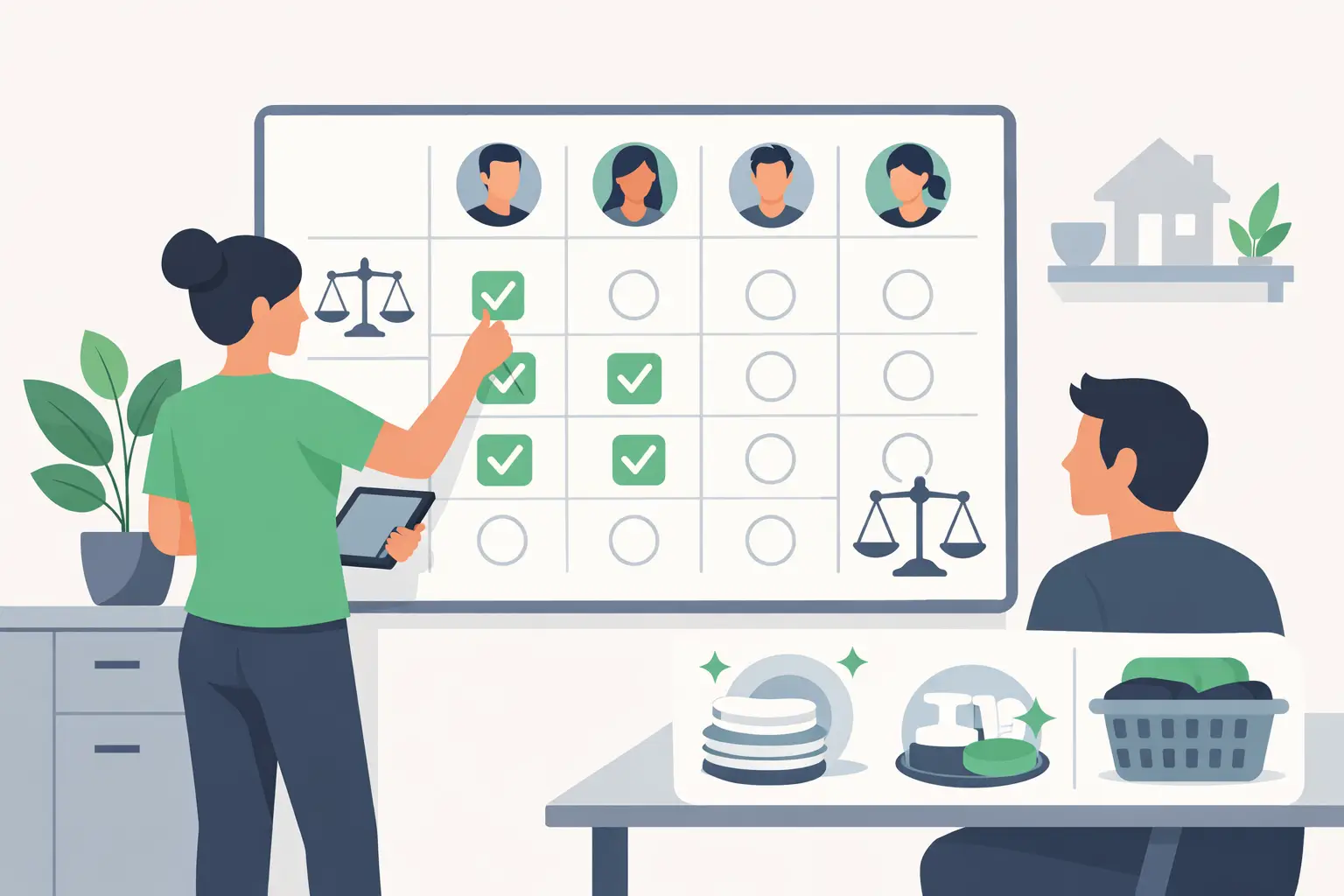
Someone always notices the trash before anyone else. Someone else remembers the bathroom soap, wipes the counters, and quietly resets the room after everyone leaves. Then, when tension finally surfaces, the argument is rarely about one plate in the sink. It is about a pattern. A fairness tracker for chores helps make that pattern visible before it turns into resentment.
That matters because most shared spaces do not fail from lack of good intentions. They fail from invisible labor, fuzzy expectations, and memory-based debates nobody can win. One person feels overburdened. Another feels unfairly blamed. A third genuinely thinks they are doing their part because no one has defined what “their part” actually means. When contribution stays vague, conflict gets personal fast.
What a fairness tracker for chores actually tracks
A basic chore list tells you what needs to get done. A fairness tracker for chores answers the harder question: who is carrying the load over time?
That distinction is the whole point. Shared labor is not just about completion. It is about distribution, frequency, effort, and follow-through. Taking out the trash once is not equivalent to cleaning a kitchen after a dinner rush, resetting a retreat room, or managing weekly inventory in a café. If every task gets treated as equal, the system looks neat while the lived experience still feels unfair.
A real fairness tracker accounts for more than checkmarks. It can assign weight to tasks based on time, effort, or unpleasantness. It can rotate recurring jobs so the same person is not always stuck with the worst ones. It can show trends over weeks, not just what happened yesterday. And it can surface imbalance early, while people still have enough goodwill to fix it.
This is where many households and small teams get tripped up. They assume fairness means everyone does the same number of tasks. That is sometimes true, but often it is not. Fairness is closer to balanced contribution than identical activity. Two people can have different schedules, different strengths, and different availability, while still sharing responsibility in a way that feels honest.
Why chore tension gets emotional so quickly
Shared work is practical. The feelings around it are not.
When labor goes unseen, people start building private stories. “I always do the hard stuff.” “They only help when I ask.” “If I do not manage this, nothing happens.” Those stories may be partly true, partly exaggerated, or completely avoidable. But once they settle in, every missed task starts to confirm them.
That is why fairness tracking works better than repeated reminders alone. Reminders can help people remember. They do not resolve the underlying question of whether the work itself is being shared fairly. If one roommate gets pinged about dishes every night while another never has to think about bathroom cleaning, reminders just make the imbalance more efficient.
Visibility changes the conversation. Instead of arguing from memory, people can look at actual contribution patterns. Instead of “I feel like I do everything,” the conversation becomes “Here is what has been assigned, completed, rotated, and left uneven over the last month.” Resentment loses its hiding place.
The difference between a chore chart and a fairness system
A chore chart is static. Life is not.
People travel. Kids get sick. One employee covers a busy weekend. One roommate works late all week. A family member takes on extra mental load that never makes it onto a whiteboard. If your system cannot adapt to shifting capacity, it will start fair and drift out of balance almost immediately.
A fairness system is designed for real life. It should handle recurring responsibilities, skipped turns, reassignments, and uneven task difficulty without forcing someone to manually recalculate everything. It should show whether the burden is concentrating around one person, one shift, or one type of task. And it should make adjustments without turning one person into the household manager by default.
That last part is often overlooked. Plenty of chore systems accidentally create a new unpaid job: maintaining the chore system. If one person has to chase everyone, rewrite assignments, explain expectations, and follow up on missed work, then the fairness problem has simply changed clothes.
What to look for in a fairness tracker for chores
The best tool is not the one with the longest feature list. It is the one people will actually keep using after the first motivated week.
Start with recurring task setup. Shared spaces run on repeat work, not one-off to-dos. Dishes, closing duties, trash, floors, restocking, bathroom resets, laundry, and common-area cleaning all need a home in the system. If recurring tasks are clunky to build, the tracker will not last.
Next, look for effort-weighted values. This is where fairness becomes measurable instead of performative. A five-minute wipe-down should not count the same as a full kitchen reset. Weighting helps the score reflect reality, which is essential if you want people to trust it.
Rotation matters too. In most groups, conflict is not just about volume. It is about who always gets the annoying jobs. Rotating responsibility keeps patterns from hardening into roles nobody agreed to.
Then there is visibility. You want a live picture of contribution, not a spreadsheet that only gets updated after someone complains. A clear fairness score or comparable metric gives everyone the same reference point. It also lowers the social cost of speaking up because the imbalance is already visible.
Finally, look for low-friction follow-through: reminders, simple completion logging, notes, calendar views, and enough flexibility to handle different kinds of spaces. A couple managing home chores and a café manager coordinating opening and closing tasks have different workflows, but they share the same core need. They need fairness without extra drama.
Fairness is not always equal, and that is okay
This is where nuance matters.
A good fairness tracker should not force artificial symmetry when the group has agreed on something else. Maybe one partner cooks while the other handles cleanup and laundry. Maybe one roommate pays more rent and does fewer tasks. Maybe a retreat center has different expectations for weekday and weekend staff. The point is not mathematical sameness. The point is visible agreement.
That means your system should reflect your real arrangement, not an abstract ideal. If someone has lower capacity for a season, adjust the load. If one task requires special skill, assign it accordingly. If your team has split roles, track within those boundaries. Fairness works when people can see the logic behind the distribution.
The danger is when exceptions become habits and habits become assumptions. A temporary imbalance is fine when everyone understands it. A permanent invisible imbalance is where burnout starts.
How to start using a fairness tracker without a big rollout
Keep the first version simple enough that nobody needs a meeting to understand it.
Start by listing the recurring tasks that quietly keep your space functioning. Not the aspirational ones - the real ones. Then assign rough effort values based on time, mess, frequency, or difficulty. After that, decide how responsibilities should rotate and how often people need reminders.
Run the system for two weeks before making big judgments. You are not just tracking chores. You are learning where the hidden load lives. Often the early surprise is not who is doing less. It is which jobs were never counted in the first place.
At that point, small adjustments matter more than perfect design. Reweight a task that was underestimated. Split one oversized responsibility into smaller recurring pieces. Change a rotation that looked fair on paper but fails in practice. Good fairness systems improve through visibility, not guesswork.
For groups that want a faster path, platforms like Nudge are built specifically for this problem: recurring shared work, weighted effort, and a live fairness view that makes imbalance hard to ignore and easier to fix.
Why this works better than “just communicating more”
Communication matters. But communication without shared evidence often turns into a debate about perception.
A fairness tracker gives your group a neutral reference point. It reduces the emotional labor of having to prove that something feels off. It also protects the person who thinks they are contributing more than they actually are. Clear data is good for both sides. It creates accountability without turning every conversation into a confrontation.
More than that, it changes behavior upstream. When people know contribution is visible, they tend to follow through more consistently. Not because they are being punished, but because expectations are no longer foggy. The system answers questions before they become arguments.
Shared spaces do better when fairness is operational, not assumed. If the work that keeps your home, business, or community running is real, then the way you measure it should be real too. Peace usually does not come from one more reminder. It comes from finally making the invisible visible.