

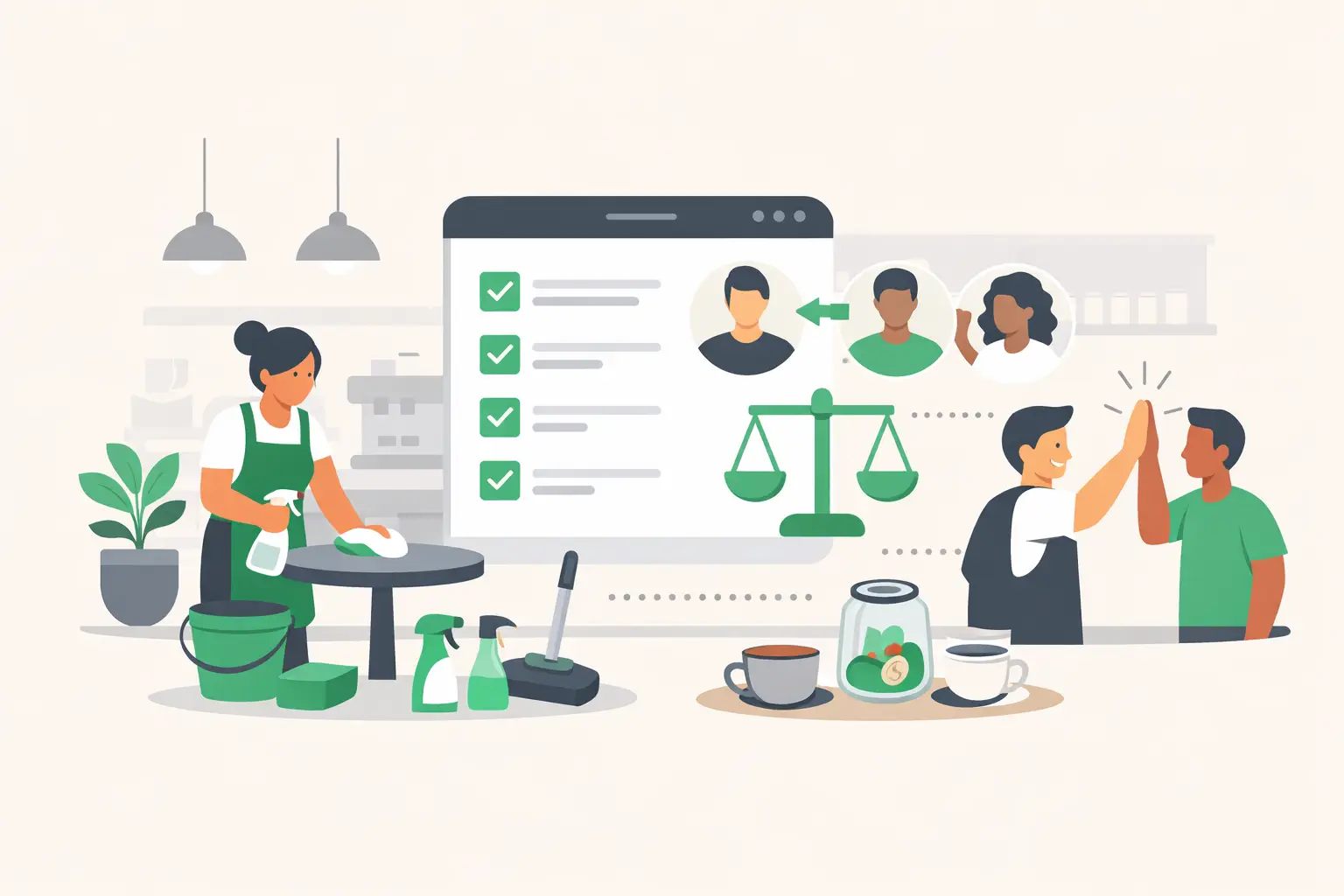
The coffee rush ends, chairs go up, and then the real friction starts. Someone wipes the espresso bar. Someone else vanishes when it is time to mop. A few tasks get done well, a few get skipped, and by the end of the week everyone is sure they are doing more than everyone else. A cafe cleaning checklist app fixes more than forgotten tasks. It makes the work visible, repeatable, and fair.
For small cafe teams, that matters more than most owners realize. Cleaning is not just a hygiene issue or a closing-shift routine. It is one of the fastest ways resentment builds in shared work. When the same person is always restocking the bathroom, scrubbing the sink trap, or taking out soaked trash bags, the problem is not only cleanliness. It is invisible labor.
Why a cafe cleaning checklist app matters
A paper checklist can help with consistency, but it has limits. It sits on a clipboard, gets coffee spilled on it, and tells you almost nothing about who keeps carrying the load. A basic to-do app is not much better. It records tasks, but it usually treats every job as equal and every missed task as a personal failure instead of a systems problem.
In a cafe, the work is uneven by nature. Deep-cleaning the grinder is not the same as refilling napkins. Closing duties take more effort than a mid-shift wipe-down. Weekend staff often inherit heavier messes than weekday openers. If your system only asks, "Was the task checked off?" you miss the bigger question: "Was the workload shared fairly?"
That is where the right app earns its place. It helps managers standardize recurring cleaning work, assign responsibilities clearly, and spot imbalance before it turns into burnout or passive-aggressive shift notes.
What a good cafe cleaning checklist app should actually do
The best tool is not the one with the most features. It is the one your team will actually use during a busy service week.
First, it should handle recurring tasks well. Cafe cleaning is repetitive on purpose. Opening wipe-downs, restroom checks, closing sanitation, weekly machine maintenance, and monthly deep cleans all need different cadences. If the app makes recurring scheduling clunky, the team will stop trusting it.
Second, it should be easy to assign by shift, role, or zone. Baristas, shift leads, and managers do not all own the same tasks. A good system reflects how your cafe actually operates. If one location has a pastry case and another does not, those differences should be simple to set up without rebuilding the whole checklist.
Third, reminders need to be timely without becoming noise. Too many alerts and staff tune them out. Too few and tasks drift. Good reminder logic respects the rhythm of a real shift.
Fourth, the app should show completion history. Not to shame people, but to remove guesswork. When a manager can see whether the milk fridge coils were cleaned last Tuesday or skipped three times, coaching gets more factual and less emotional.
And if you want the system to reduce conflict instead of just organizing it, fairness tracking matters. Not every cleaning task costs the same effort. A stronger setup accounts for workload weight so one person is not quietly stuck with the grossest, longest, or most physically demanding jobs every week.
The hidden cost of uneven cleaning work
Most cafe owners notice cleanliness issues before they notice fairness issues. Customers see a streaky front door or a sticky syrup station. Staff feel the deeper problem first.
When cleaning assignments stay vague, dependable employees pick up the slack. At first, that looks like teamwork. Over time, it becomes a tax on the people who care most. They move faster, stay later, and carry the mental load of remembering what still needs attention. Meanwhile, less consistent staff can look equally helpful on paper because nobody is tracking effort, only presence.
That is how resentment hides. It shows up as eye-rolling during close, tension in the group chat, and high performers getting tired of being the unofficial cleanup crew. A better system gives resentment fewer places to hide.
How to set up a cafe cleaning checklist app without overcomplicating it
Keep the first version simple. Most cafes do not need a giant operations rebuild. They need a shared source of truth.
Start by grouping tasks into daily open, during-shift, daily close, weekly, and monthly categories. That gives your team a natural rhythm and makes it easier to assign work at the right level. A restroom check every two hours should not live beside a monthly floor drain deep clean as if they are the same kind of task.
Then break tasks by area. Front counter, bar, kitchen, seating, restrooms, storage, and exterior are common zones. This cuts down on the classic end-of-night confusion where everyone assumes somebody else handled one forgotten corner.
After that, assign realistic effort values. This is the part many teams skip, and it is why "equal" assignments often still feel unfair. Taking out trash, breaking down the bar, and scrubbing mats are heavier than refilling lids. If your app lets you weight or score tasks, use it. If it does not, you are still relying on manager memory to notice imbalance.
Finally, build a clear review habit. Look at completion trends once a week. Not because every missed wipe-down is a crisis, but because patterns matter. If one shift constantly leaves work unfinished, the issue might be staffing, training, timing, or poor task distribution. An app should help you diagnose that, not just document failure.
When simple checklists are enough - and when they are not
Not every cafe needs advanced analytics on day one. A very small team with stable staffing might do fine with a lightweight checklist system if everyone already trusts one another and responsibilities are genuinely balanced.
But if you have turnover, rotating shifts, multiple closers, or growing tension around who does what, basic checklists stop being enough. That is especially true when managers are spending time mediating complaints like, "I always clean the bathrooms," or, "Night crew leaves everything for opening." At that point, the issue is not task visibility alone. It is contribution visibility.
This is where a fairness-first platform stands apart from a generic task app. Nudge, for example, is built around the idea that shared work should be measurable, not guessed at. That means recurring assignments, task rotation, and effort-based visibility can all work together. For a cafe team, that creates something rare: a cleaning system that supports accountability without turning the manager into a full-time referee.
What managers should watch after rollout
The first win is usually consistency. More tasks happen on time because people know what is expected. The second win is clarity. Fewer arguments start with, "I thought someone else had it."
The more meaningful shift comes a little later. Teams begin to trust the system because it reflects reality. If a closer had the heaviest cleaning load three shifts in a row, that should be visible. If the same person keeps catching overdue maintenance tasks, that should be visible too. Once the work is visible, better decisions follow.
That might mean rotating hard jobs more intentionally. It might mean changing staffing on your busiest close. It might mean realizing your checklist is too ambitious for the labor hours you actually schedule. Those are useful truths. A good app does not just keep standards up. It shows where your operation is unfair or unrealistic.
The best outcome is not a cleaner checklist
It is a calmer team.
A cafe cleaning checklist app should absolutely help you pass inspections, standardize routines, and protect the customer experience. But the bigger payoff is cultural. People stay more engaged when expectations are clear and the burden is shared. Managers spend less energy chasing basic tasks. Staff spend less time keeping score in their heads.
That is what makes the right app worth adopting. Not because it digitizes a clipboard, but because it turns recurring friction into something your team can actually see and fix. When cleaning stops being a quiet source of imbalance, the whole space runs better.
If your cafe already has standards but still struggles with follow-through, the missing piece may not be another checklist. It may be a system that makes fairness part of the workflow, not an afterthought.