

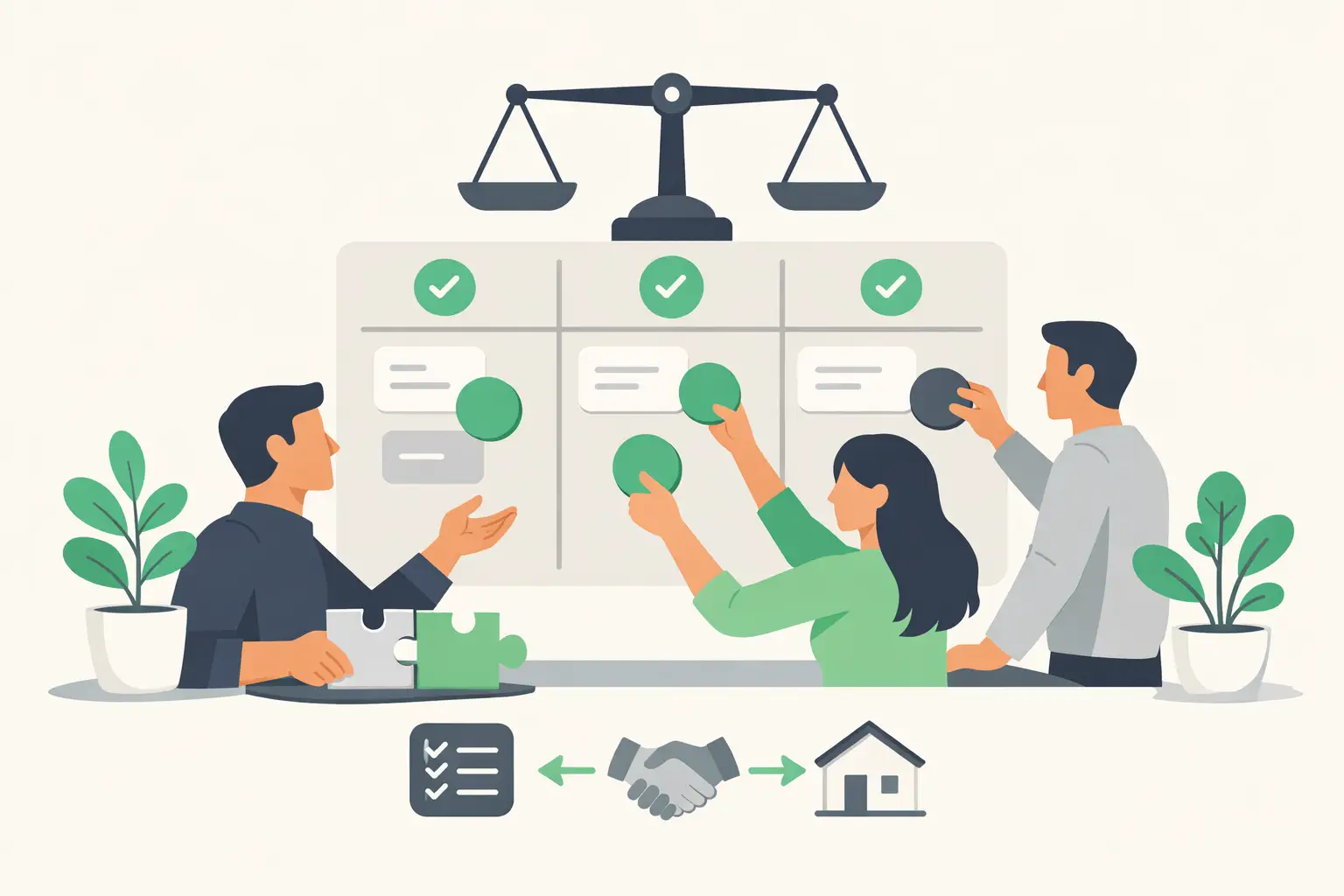
That fight usually does not start with the trash. Or the closing shift checklist. Or who forgot to wipe down the shared kitchen again. It starts earlier, when work is happening unevenly and nobody can fully prove it. If you want to organize shared responsibilities without arguments, the real goal is not better reminders. It is making contribution visible before resentment takes over.
Most groups do not fail because people are lazy. They fail because shared labor is fuzzy. One person thinks they are doing the heavier work. Another thinks they are doing plenty. A third is helping in ways nobody tracks. When effort stays invisible, every conversation turns personal. People stop discussing the system and start defending themselves.
That is why the fix has to be structural. You need a setup that reduces ambiguity, spreads effort fairly, and makes follow-through easy to see. In homes, cafés, retreat spaces, and small teams, the pattern is the same. The calmer the system, the fewer emotional blowups it creates.
Why shared responsibility turns into conflict so fast
Shared work gets emotional because it touches dignity, respect, and reliability. If you are the one who keeps noticing what is missing, you are not just annoyed. You are carrying the mental load of seeing, remembering, and compensating. That burden is exhausting precisely because it is easy for others to miss.
On the other side, people who feel accused often believe they are being judged unfairly. Maybe they completed tasks nobody recognized. Maybe expectations changed without a real conversation. Maybe "help out more" was never translated into clear actions. That is how simple operational problems become relationship problems.
The answer is not stricter policing. It is shared clarity. People handle responsibility better when the rules are explicit, the workload is visible, and the distribution feels fair.
To organize shared responsibilities without arguments, start with visibility
Before you assign anything, identify what is actually being shared. Many groups only track the obvious jobs and ignore the work that quietly drains time. Cleaning the bathroom gets counted. Restocking supplies, checking inventory, resetting the meeting room, taking out recycling, and noticing when the coffee filters are gone often do not.
This is where arguments usually begin. The visible jobs are discussed. The invisible jobs are absorbed by whoever is most conscientious. Over time, that person starts feeling like the unpaid backup system for everyone else.
A better starting point is a complete list of recurring responsibilities. Not a perfect one. A useful one. Weekly resets, daily maintenance, occasional deep-clean tasks, opening duties, closing duties, supply runs, admin check-ins - if it happens regularly, it belongs in the system.
Once everything is named, the emotional temperature drops a little. People no longer have to argue about whether work exists. They can see it.
Fair does not always mean equal
This is where many systems break. Groups divide tasks evenly by count, then act surprised when people still feel bitter. Five responsibilities are not equal if one takes three minutes and another takes forty. A quick wipe-down is not the same as handling laundry for a shared rental or doing the end-of-night café close.
If you want fairness, track effort, not just quantity. That means weighting responsibilities by time, frequency, difficulty, or disruption. The person taking the heaviest recurring burden should not also be expected to quietly pick up all the small extras.
There is some judgment involved here, and that is fine. Not every task can be measured perfectly. But rough effort values are still better than pretending all chores carry the same load. Fairness works when people can recognize themselves in the system.
Put recurring work on rotation when possible
Static ownership works for some groups. If one roommate always handles bills and another always handles yard work, that may be efficient. But fixed roles can also trap one person in the least pleasant category of work for months. That is when people start saying yes outwardly and building resentment inwardly.
Rotation solves part of this problem because it distributes inconvenience, not just task completion. Everyone gets firsthand experience of what the work actually requires. That matters. People are more respectful of shared labor when they have done it themselves.
Still, rotation is not always the right choice. In a small business, some responsibilities should stay with trained staff. In a household, one person may genuinely prefer cooking while another prefers cleaning. The key is consent plus visibility. If tasks are fixed, the trade-off should be explicit and balanced elsewhere.
Make ownership specific enough to prevent "I thought someone else had it"
Vague responsibility creates perfect conditions for conflict. "We should keep the common area clean" sounds cooperative, but it is operationally useless. No one knows what counts, when it is due, or who is responsible today.
Specific ownership changes the tone immediately. Monday bathroom reset. Wednesday trash and recycling. Friday inventory check before close. Dining room wipe-down at the end of each shift. The more concrete the task, the less room there is for passive confusion.
This does not mean turning your shared space into a bureaucracy. It means removing the gray areas that create repeated friction. Adults do not need constant supervision. They need a system that does not rely on mind reading.
Use reminders, but do not mistake reminders for accountability
A reminder is helpful. A reminder is not a fairness system.
Plenty of groups rely on group chats, sticky notes, or verbal check-ins. These work for a week, then collapse under repetition. Someone forgets. Someone else follows up. The same person becomes the human reminder engine, which is just another invisible job.
To organize shared responsibilities without arguments, you need accountability that lives outside one person's memory. Recurring tasks should reappear automatically. Completion should be visible. Missed work should be obvious without a dramatic confrontation. That is the difference between managing chores socially and managing them operationally.
This is why fairness-focused tools work better than generic to-do lists for shared environments. A checklist can tell you what exists. It usually cannot show whether one person is carrying more weight over time. When contribution becomes measurable, resentment loses its hiding place.
Talk about the rules before the next failure
The worst time to negotiate responsibilities is right after someone drops the ball. In that moment, everyone is defending themselves. You are not designing a system. You are arguing inside a fresh irritation.
Set expectations during a calm moment instead. Decide what counts as done, how often tasks rotate, how much flexibility exists, and what happens when someone misses their part. Keep it practical. If a task can slide by a day, say so. If a closing duty must happen before anyone leaves, say that too.
This matters in homes just as much as in businesses. Couples fight less when they are discussing standards rather than each other's character. Teams work better when the process is settled before pressure hits.
Watch the pattern, not the one-off mistake
Nobody needs a fairness tribunal because they forgot one task during a chaotic week. Arguments grow when isolated misses become recurring imbalances and no one addresses them clearly.
That is why patterns matter more than incidents. Is one person consistently taking the high-effort jobs? Is someone completing visible tasks but avoiding less noticeable work? Is one manager always covering gaps after everyone else leaves? Those trends tell you whether the system is healthy.
A live fairness view helps because it shifts the conversation away from blame and toward calibration. Instead of "you never help," the real discussion becomes "the workload has drifted and we need to rebalance it." That is a very different conversation.
Keep the system light enough that people will actually use it
Some groups overcorrect. They build a detailed process so complicated that nobody sticks with it. If managing responsibilities feels like a second job, the system itself becomes a source of resistance.
Aim for enough structure to create clarity, not so much that it becomes tedious. Shared templates, recurring schedules, simple notes, and visible contribution data are usually enough. The best system is the one people can maintain on an ordinary Tuesday, not just during a burst of motivation.
This is where a platform like Nudge can help. It does the unglamorous part well - rotating recurring work, weighting effort, and making fairness visible without forcing one person to play referee.
What a low-conflict setup actually looks like
In practice, the healthiest setups share a few traits. Everyone knows what exists. Responsibilities are assigned clearly. Higher-effort work is recognized, not hidden. Recurring tasks do not depend on one person's memory. And when imbalance appears, the group can see it early enough to fix it before the mood sours.
That kind of system does not remove every hard conversation. People still get busy. Standards still differ. Life still interrupts routines. But the conversation changes. Instead of replaying the same emotional argument, you have something concrete to adjust.
Shared spaces run better when fairness is visible. Not because people need to be monitored, but because most conflict around responsibility comes from guesswork. Replace guesswork with a fair system, and the room gets quieter in the best possible way.