

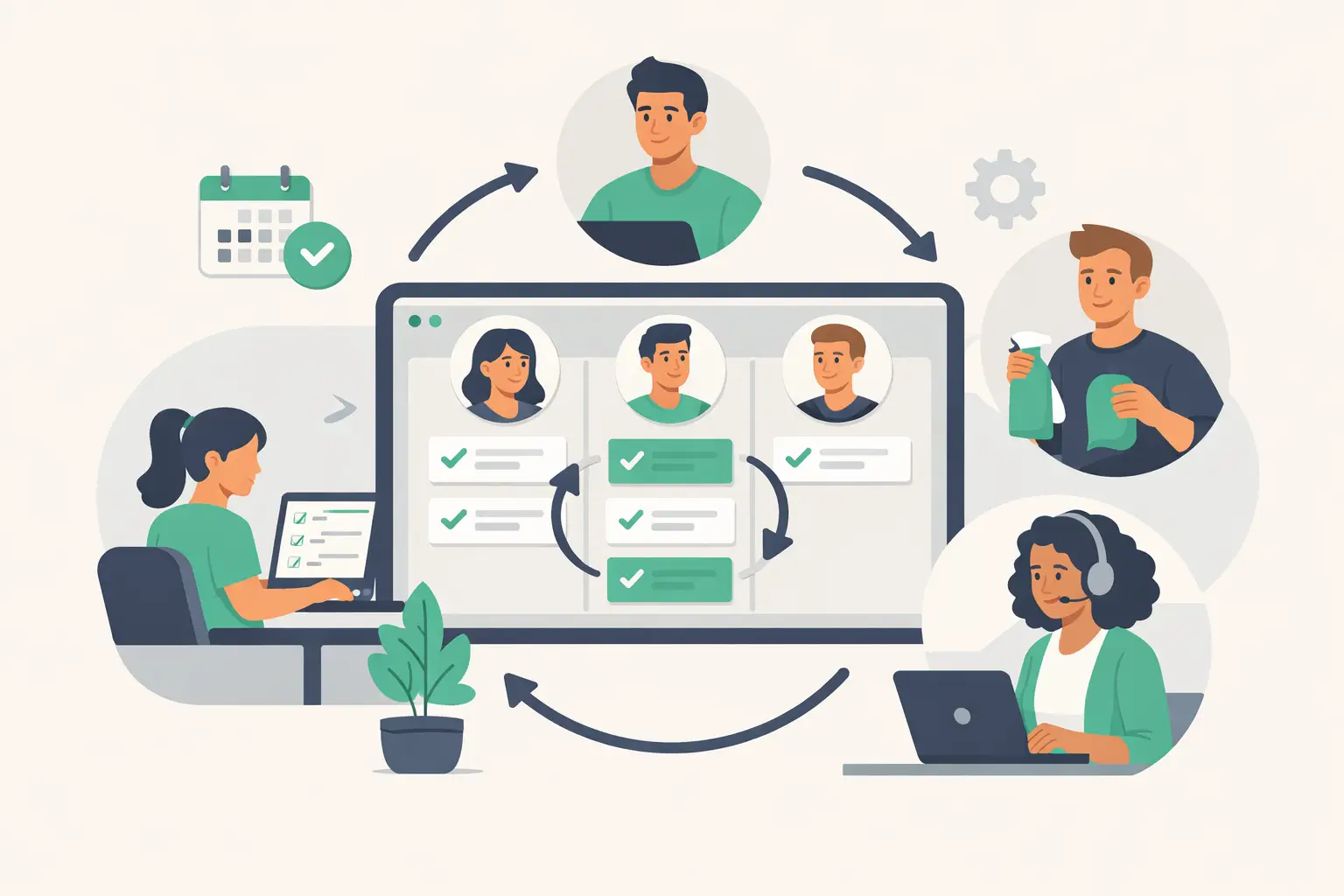
If the same person is always restocking supplies, wiping tables, closing up, or handling the jobs nobody wants, your problem is not motivation. It is visibility. Staff task rotation software exists for exactly this reason - to stop recurring work from becoming invisible labor and make fairness part of daily operations.
For small teams, shared spaces, and service environments, recurring tasks create a particular kind of tension. They are too small to become a formal project, but too constant to ignore. Over time, the same pattern appears: one person takes initiative, another forgets, a manager starts chasing updates, and resentment grows in the gaps. The issue is rarely the task list itself. The issue is how work gets distributed, tracked, and remembered.
What staff task rotation software actually solves
Most teams do not need another place to write down tasks. They need a system that handles repetition without creating social friction. That is where staff task rotation software earns its place.
At its best, it does three jobs at once. It rotates responsibilities so the same people are not always stuck with the same work. It creates accountability so nobody has to rely on memory or awkward reminders. And it makes contribution visible, which matters more than many managers realize.
Visibility changes the tone of the room. When everyone can see who handled opening checks this week, who took the extra cleaning shift, or who has been covering the less desirable jobs, blame has less room to thrive. Resentment loses its hiding place.
Why spreadsheets and generic to-do apps fall short
A spreadsheet can assign names to tasks. A basic task app can send reminders. Neither is built around fairness.
That matters because recurring shared work is not just an operations problem. It is an emotional one. In a café, uneven side work can quietly damage morale. In a retreat center, missed cleaning rotations can turn into staff burnout. In a family business or community space, the problem often gets personal fast because everyone sees the imbalance but no one has a clean way to address it.
Generic tools also tend to treat every task as equal. Real life does not. Taking out trash once is not the same effort as deep cleaning a kitchen, handling close, or resetting an event space. If your tool cannot account for effort, your rotation may look equal on paper while still feeling unfair in practice.
The features that matter most in staff task rotation software
Not every team needs advanced scheduling logic, but every shared-space team needs clarity. The best staff task rotation software usually includes recurring schedules, automated assignments, reminders, and a simple view of what is due now versus later.
The next layer is where the difference shows. Good software lets you weight tasks by effort instead of counting everything the same. It keeps a record of who has done what over time. It allows notes, exceptions, and swaps without making the whole system collapse. And it gives managers or group leaders a quick way to spot imbalance before it becomes conflict.
A calendar view helps when tasks are tied to shifts or days of the week. Team segmentation matters if different groups handle different zones, such as front-of-house and back-of-house, or weekday staff versus weekend staff. Offline access can matter more than people expect, especially in spaces with spotty service or lots of movement.
The strongest platforms go one step further and measure fairness directly. That changes the conversation from vague feelings to visible patterns. Instead of asking, "Why am I always doing more?" your team can look at actual contribution data.
Fair rotation is not the same as equal rotation
This is where many setups fail.
Equal rotation sounds reasonable until you look closer. If one employee gets assigned a quick checklist item and another gets a physically heavier or more time-consuming job, equal assignment can still create unfair outcomes. Staff task rotation software should help you account for that difference.
Fair systems recognize effort, frequency, and context. A closing duty that takes 25 minutes should not be treated the same as a two-minute restock. A task that interrupts customer service during peak hours carries a different burden than one completed quietly before opening. When software reflects those realities, people are more likely to trust it.
Trust matters because a rotation system only works if people believe it is not quietly favoring the loudest person, the most organized person, or the one least likely to complain.
Who benefits most from this kind of software
The obvious use case is a small business team with recurring operational chores. Cafés, studios, clinics, and hospitality spaces often have dozens of small repeat tasks that keep the place functional but rarely make it into formal management systems.
But the same logic applies to households, roommate groups, co-living spaces, and retreat properties. Any setting where people share responsibility for a physical environment can benefit from staff task rotation software, even if the users are not traditional staff. What matters is the pattern: recurring work, shared ownership, and a history of uneven follow-through.
Smaller teams often feel this most sharply. In a group of six, everyone notices when one person keeps carrying more. In a team of three, one missed rotation can affect the entire week. Lightweight software works well here because the need is urgent, but the appetite for complicated setup is low.
What to look for before you choose a tool
Start with your real problem, not the feature list. If your issue is missed tasks, reminders and recurring scheduling may be enough. If your issue is resentment about invisible labor, you need contribution tracking and fairness visibility. If you manage multiple spaces or sub-teams, segmentation and shared dashboards matter more.
It also helps to think about behavior, not just functionality. Will your team actually check the app? Can someone understand what to do in under a minute? Does the system make exceptions easy when someone is sick, late, or covering a shift? The more friction you add, the faster people fall back to hallway conversations and sticky notes.
A good rule is this: the software should reduce management effort, not create a new layer of it. If it takes constant manual correction, it will become one more chore assigned to the most responsible person.
Implementation is where success or failure happens
Even the right staff task rotation software can fail if the rollout feels punitive. People need to understand that the goal is not surveillance. The goal is fairness, consistency, and less emotional guesswork.
Start small. Pick the recurring tasks that cause the most friction first. Set clear effort values if the platform supports them. Make assignments visible to everyone. Then give the system a short trial period and review what the data shows.
This is often the moment when teams notice something useful. The person who felt overburdened finally has proof. The person who thought they were contributing evenly may realize they were not seeing the full picture. Neither outcome has to turn adversarial if the tool is framed correctly. The point is not to shame anyone. It is to make shared responsibility actually shared.
One fairness-first platform, Nudge, is built around that exact idea: recurring task rotation paired with measurable contribution tracking. That combination matters because completed work is only half the story. The real win is reducing the tension that comes from work nobody can quite prove is uneven.
The trade-offs are real
Not every environment needs fairness scoring. Some teams simply need a better rotation calendar. Others may resist any system that feels too quantified, especially if trust is already low. In those cases, software should support conversation, not replace it.
There is also a balance between automation and flexibility. Too much automation can feel rigid when real life changes daily. Too little automation defeats the purpose. The best tools usually let you automate the predictable parts while leaving room for swaps, notes, and exceptions.
And yes, software cannot fix a culture where managers regularly dump undesirable work on the same people. But it can make that pattern visible faster, which is often the first step toward changing it.
Why this matters more than it seems
Recurring tasks look small until they start shaping how people feel about each other. A missed wipe-down, an unfair close, an always-someone-else problem - these are rarely just operational glitches. They become stories people tell themselves about who cares, who coasts, and who gets taken for granted.
That is why staff task rotation software matters. Not because it makes a checklist prettier, but because it turns shared labor into something clear enough to manage and fair enough to trust. When responsibility is visible, teams spend less energy chasing, reminding, and quietly keeping score.
If your space depends on people doing the little things reliably, do not wait for those little things to become big conflicts. The right system gives everyone the same message: the work counts, the effort is seen, and fairness is not a vague ideal - it is part of how the place runs every day.