

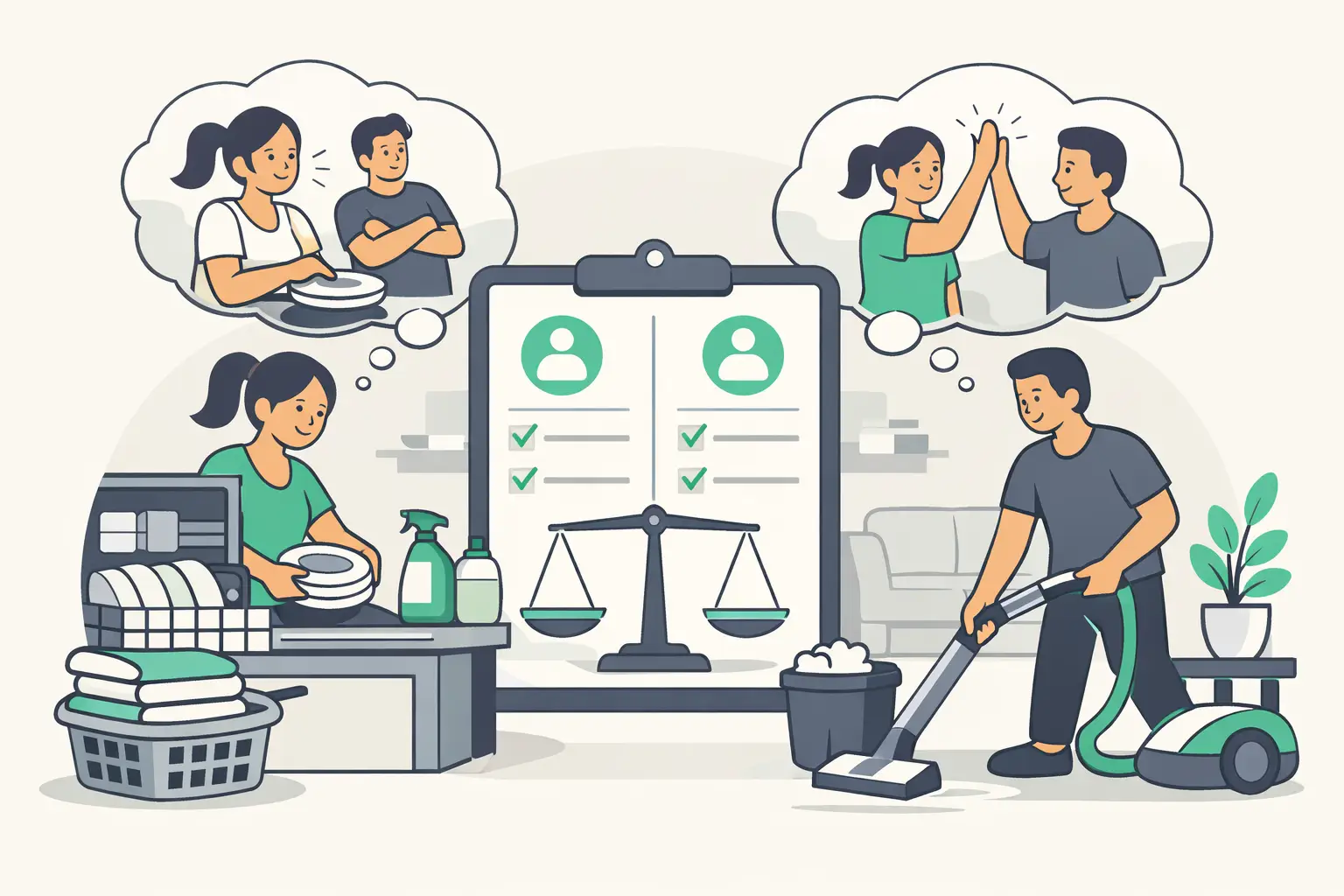
The dishwasher is full, the trash is overflowing, and everyone can see it. Yet one person eventually handles both. Again. That is how shared work becomes personal frustration. Learning how to prevent chore resentment is not about making people love cleaning, restocking, closing shifts, or taking out bins. It is about making contribution visible, expectations clear, and follow-through shared.
Chore resentment rarely starts with one missed task. It builds when the same person has to notice, remember, plan, remind, and finish the work that keeps a shared space running. The visible task may be wiping a counter. The invisible labor is seeing that it needs to be wiped before someone complains.
For roommates, couples, families, cafés, retreat centers, and small teams, fairness is not a nice extra. It is part of running the space well.
Why chore resentment takes hold
The most damaging chore systems are often the least explicit. People say, “We all pitch in,” but no one defines what pitching in means. One person thinks loading the dishwasher counts as handling dishes. Another sees unloading it, wiping the sink, buying detergent, and noticing when the cycle needs to run as part of the same job.
Neither person is necessarily lazy or unreasonable. They are working from different definitions of done.
Resentment also grows when tasks are treated as equal simply because they are all called chores. Taking out the trash once a week is not the same as managing meals, resetting a café at closing, coordinating laundry, or cleaning shared bathrooms. Frequency, time, physical effort, unpleasantness, and planning load all matter.
Then there is the reminder problem. If one person has to ask every time, they are still carrying the management burden even when someone else completes the task. “Just tell me what to do” can sound cooperative, but over time it makes one person the unpaid operations manager of the household or team.
How to prevent chore resentment with clear ownership
The simplest rule is this: shared responsibility does not mean vague responsibility. Every recurring task needs an owner for a defined period.
Ownership means more than being the person who helps when asked. It means noticing when the task is due, completing it to an agreed standard, and communicating early if it cannot be done. A roommate who owns recycling handles it without waiting for the bin to become a group argument. A café employee assigned to the closing restock checks supplies before the next shift discovers the problem.
Start by naming the work that actually keeps your space functioning. Include recurring jobs, occasional deep-cleaning, supply runs, admin tasks, and the behind-the-scenes work people tend to overlook. If a task causes frustration when it is missed, it belongs on the list.
Next, define what “done” looks like. This is not about creating a courtroom-level rulebook. It is about removing the loopholes that create repeat conflict. “Clean the kitchen” is vague. “Load or unload the dishwasher, wipe counters and stovetop, clear food from the sink, and take out full trash” is clear.
For busy shared spaces, add timing. Is the task due daily, after each use, before opening, at the end of a shift, or by Sunday evening? A task without a cadence becomes a task someone has to chase.
Make the invisible work visible
Some jobs are easy to see after they are missed. A dirty bathroom announces itself. Other work disappears because it happens before there is a problem: ordering paper towels, checking whether guests have clean linens, scheduling maintenance, or keeping track of who covered last week’s shift.
Put this work in the same system as physical chores. If it takes time, attention, or emotional energy, it counts. Fairness breaks down when only the jobs with a mop or trash bag are recognized.
Share effort, not just task names
A rotating chart can look equal while feeling deeply unfair. The reason is simple: people are not rotating equal effort.
Give tasks a rough effort value based on time, frequency, inconvenience, and mental load. You do not need to debate whether cleaning a bathroom is worth 3.2 points versus 3.5. The goal is to make obvious imbalances harder to ignore.
For example, a weekly supply run may carry more weight than emptying a small bin, while a daily opening checklist may be lighter per occurrence but substantial across a month. Some tasks are unpleasant. Some require planning. Some are urgent when they fail. Your system should reflect that reality.
This is where a simple fairness tracker can help. Nudge, for example, lets groups assign effort-weighted values, rotate recurring responsibilities, and see a live Fairness Score. The point is not to turn home life or a small team into a spreadsheet contest. The point is to give resentment fewer places to hide.
There is a trade-off here. A highly detailed scoring system can feel rigid if your group only has a few simple chores. Use as much structure as the situation needs. A two-person apartment may need a short rotating list and a weekly check-in. A retreat center with multiple turnover tasks, rotating staff, and guests arriving on schedule needs more visibility.
Stop relying on memory and goodwill
Good intentions are not a dependable operating system. People forget, work runs late, kids get sick, shifts change, and a task that lives only in someone’s head is easy to miss.
Use recurring reminders and a shared calendar for recurring work. The reminder should go to the person responsible, not to the person most likely to notice the task was skipped. That small distinction protects the group from the parent-child dynamic that often poisons chore conversations.
Make it easy to mark work complete, leave a note, or flag a problem. If the mop is broken, the closing supplies are missing, or the person assigned to laundry is traveling, the group needs a visible handoff rather than silence. Accountability works best when people can communicate before a task turns into an emergency.
Avoid using reminders as a public shaming tool. A missed task should create a clear next step, not a pile-on. The aim is reliable follow-through, not winning an argument.
Build a reset process for missed chores
Even the best plan will fail sometimes. What matters is what happens next.
Agree in advance on a simple reset rule. If someone cannot complete their task, they arrange a swap, take an equivalent task later, or communicate with enough notice for the group to adjust. If they forget, they complete it promptly and take responsibility without requiring someone else to manage the repair.
This prevents the common pattern where one reliable person quietly picks up the slack because the alternative is living or working in chaos. That person may keep the space functional, but they are also absorbing the cost of everyone else’s inconsistency.
A fair system does not demand perfection. It does make patterns visible. Missing one task during a rough week is human. Repeatedly leaving the same work for someone else is a distribution problem that needs to be addressed directly.
Hold short check-ins before frustration gets loud
Do not wait until someone is furious to discuss chores. By then, the conversation is rarely about one dirty pan or missed shift. It is about weeks of feeling ignored.
Set a brief recurring check-in, especially when people move in, staffing changes, schedules shift, or a new season creates more work. Ten minutes can be enough. Ask: What feels uneven? Which tasks are unclear? Has anyone taken on work that is not being tracked? What needs to rotate or change?
Keep the conversation focused on the system before assigning blame to a person. “The bathroom schedule is not working” creates room for a fix. “You never clean the bathroom” may be true from someone’s perspective, but it usually starts a defense cycle before the practical issue is solved.
That said, kindness should not become avoidance. If one person repeatedly ignores an agreed responsibility, name the pattern plainly. Fairness requires both empathy for real constraints and accountability for repeated choices.
Let fairness adapt to real life
Equal is not always identical. One partner may be working longer hours for a month. A roommate may be recovering from an injury. A team member may be covering a major event. Temporary adjustments are reasonable when they are explicit, time-bound, and acknowledged.
The problem is not that workloads change. The problem is when a temporary imbalance becomes permanent without discussion. Say what is changing, who is covering what, and when you will revisit the arrangement. That protects generosity from turning into an unspoken expectation.
Shared spaces run better when people do not have to guess who cares, who is responsible, or who has quietly done more than their share. Make the work visible. Match effort, not appearances. Check the balance before resentment has a chance to become the loudest person in the room.