

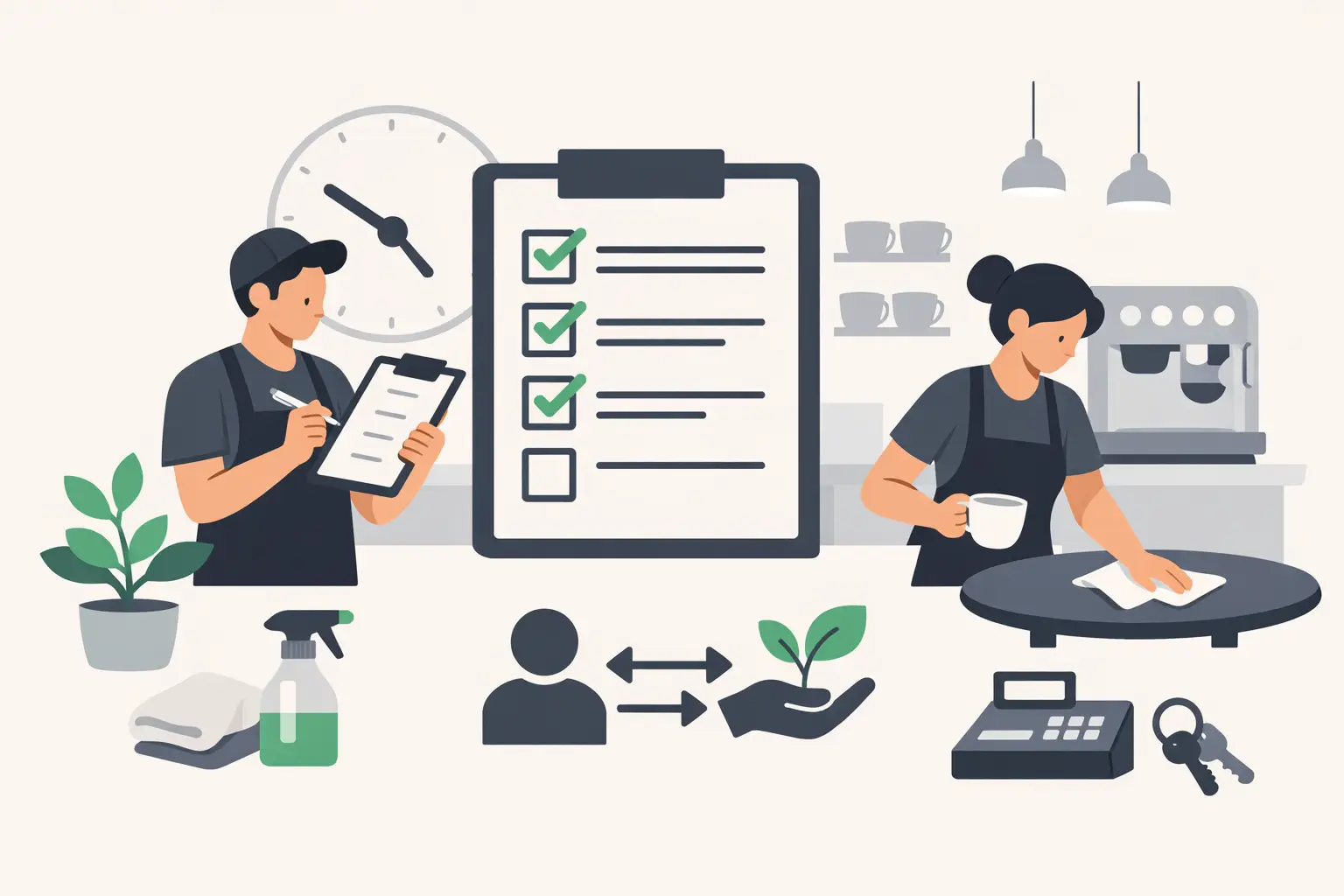
The last customer has left, the chairs are going up, and someone is already halfway out the door. That is exactly when café closing checklist ideas stop being a nice management exercise and become the difference between a clean opening and a morning full of blame. A strong close protects food safety, cash, equipment, and team morale. A vague close leaves the same reliable person doing the invisible work again.
A closing checklist should not read like a punishment assigned to whoever drew the late shift. It should make the standard clear, divide labor realistically, and create proof that the work happened. When everyone can see what a proper close requires, resentment loses its hiding place.
Start With the Non-Negotiables
Not every task carries the same risk. Build your checklist around the jobs that can affect customer safety, product quality, security, or the next shift's ability to operate. These belong on every close, even on a quiet Tuesday when the team is tired.
Food, drink, and sanitation
Closing food work needs clear standards, not instructions like “clean the bar.” Specify what clean means: wipe and sanitize espresso machine surfaces, purge and wipe steam wands, empty and rinse drip trays, wash pitchers, label and date prepared food, and move approved items into proper storage.
The same principle applies to the service line. Empty and clean condiment stations, wash blender components, remove food debris from drains, take out trash, and sanitize high-touch surfaces. If your local health requirements call for temperature logs or sanitizer checks, place them directly in the close instead of trusting memory.
Be careful not to turn the checklist into a fiction. If deep-cleaning the ice machine is a monthly responsibility, it should not appear as a nightly task. Daily lists should reflect what a normal closing crew can actually finish without rushing through sanitation.
Cash, security, and shutdown
The cash drawer needs a repeatable process: count the till, record any variance, secure cash according to policy, and confirm the register is signed out. Limit access to the final record so a missing dollar does not turn into a group accusation.
Then cover the building: lock doors and storage areas, turn off or secure music and tablets, check that ovens and nonessential equipment are powered down, and set alarms. Some equipment, such as refrigerators or display cases, must stay on, so name those exceptions. “Turn everything off” is how expensive mistakes happen.
Set up tomorrow before leaving
A café opens faster when closing staff leave the space ready rather than merely empty. Restock cups, lids, napkins, syrups, beans, milks, and cleaning supplies based on the next day’s expected volume. Flag low inventory while it is still visible.
This is also the right time to note maintenance issues: a slow grinder, a leaking fridge, a sticky door lock, or a missing delivery. A short note with a photo if needed can prevent the opener from discovering a problem during the morning rush.
Café Closing Checklist Ideas That Match Real Roles
The biggest flaw in many checklists is not what they include. It is that every line is assigned to “the closing team.” That phrase often means the fastest, most conscientious employee quietly handles what others skip.
Assign ownership by station or role. A bar closer owns espresso equipment and bar restocking. A register closer owns the till, front counter, and guest-area reset. A kitchen or prep closer owns food storage, dishes, and back-of-house sanitation. A shift lead verifies critical tasks and handles the final lockup.
Roles should be flexible, but ownership should never be fuzzy. If one person is assigned both a full dish pit and a detailed bar close while another only wipes tables, the distribution is not fair just because both names appear on the schedule.
A useful checklist can include four fields for each item: the task, the expected standard, the owner, and the completion confirmation. For example, “Clean espresso machine group heads and steam wands to closing standard - Bar closer - Initial after completion.” That leaves little room for “I thought someone else had it.”
For a small café, use a simple rotating structure:
- Bar close: espresso machine, grinders, pitchers, bar sink, milk fridge, bar stock
- Front close: register, pastry case, dining room, restrooms, trash, doors
- Back close: dishes, food labeling, prep surfaces, mop and drain check, storage areas
- Lead close: cash verification, temperature records, maintenance notes, alarm and final walkthrough
Rotation matters because some tasks are more physically demanding, more unpleasant, or more likely to run late. The person who closes dishes every night is not simply “better at it.” They may be carrying a hidden share of the work.
Make the Checklist Specific Enough to Verify
“Clean floors” can mean a quick sweep to one employee and sweep, spot-scrub, mop, and dry to another. Vague standards create friction because people argue after the work is supposedly done.
Write observable outcomes. Instead of “restock bar,” write “refill cups, lids, straws, napkins, and core syrups to marked par level.” Instead of “check bathrooms,” write “empty trash, restock paper goods and soap, wipe sink and toilet touchpoints, and confirm floor is dry.”
Add a short verification step for high-risk tasks. A lead can confirm that refrigeration temperatures were logged, the cash was secured, and food was labeled before anyone clocks out. This is not about policing every wipe-down. It is about catching the omissions that create the biggest operational or safety problems.
Photos can help for periodic deep cleans, equipment resets, or recurring trouble spots. Use them selectively. Requiring photo evidence for every small task can make people feel surveilled rather than supported.
Build for Slow Nights, Rushes, and Staffing Gaps
A checklist that only works with three closers on a quiet night is not a real system. Cafés need a core close and a fuller close.
The core close covers safety, sanitation, cash, security, and tomorrow’s minimum opening needs. The fuller close includes detailed restocking, floor care, secondary organization, and lower-risk deep-cleaning. When a late rush hits or someone calls out, the shift lead can protect the core close first and move the rest to a scheduled recovery task.
That trade-off should be visible. Skipping a low-priority shelf reorganization is different from skipping food storage or cash security. When everything is labeled urgent, people either burn out trying to do it all or start cutting corners without telling anyone.
Consider timing, too. Some tasks can begin before close without hurting service: consolidate condiments, restock dry goods, start nonessential dishes, or clean unused sections of the dining room. Pre-closing reduces the frantic final 20 minutes, but it should not shift unpaid work earlier or leave one employee serving guests while everyone else pre-closes.
Track Contribution, Not Just Completion
A checked box tells you a task was marked done. It does not tell you whether the same person has handled the hardest closing work for three weeks.
Review task history weekly. Look for patterns: Who is always assigned trash and mop? Who regularly finishes the checklist after their scheduled end time? Which tasks get left incomplete? Which closing station takes longer than the schedule allows? These are staffing and workflow signals, not character flaws.
Weight labor honestly. Taking out trash is not equivalent to closing a complex espresso bar, managing dishes, counting cash, and locking the building. A fairness-aware system, such as Nudge, can rotate recurring work and make uneven contribution visible before it becomes a passive-aggressive group chat.
This visibility also protects good employees. When managers can see that someone has repeatedly picked up incomplete tasks, they can rebalance assignments, coach the right issue, or adjust staffing rather than offering vague praise while the imbalance continues.
Keep It Alive After the First Week
The best checklist changes with your café. Review it after two weeks, then monthly or whenever the menu, equipment, staffing, or hours change. Ask closers where the list is unclear, which tasks routinely take too long, and what openers still have to fix.
Do not use feedback to make the list endlessly longer. Remove duplicate steps, combine related tasks, and move occasional work to a weekly schedule. The goal is a reliable close, not a document that proves management can imagine every possible mess.
A café close is one of the few moments when the whole next day is either protected or compromised. Give every task a clear standard, give every person a fair share, and let the team leave knowing the work was seen.