

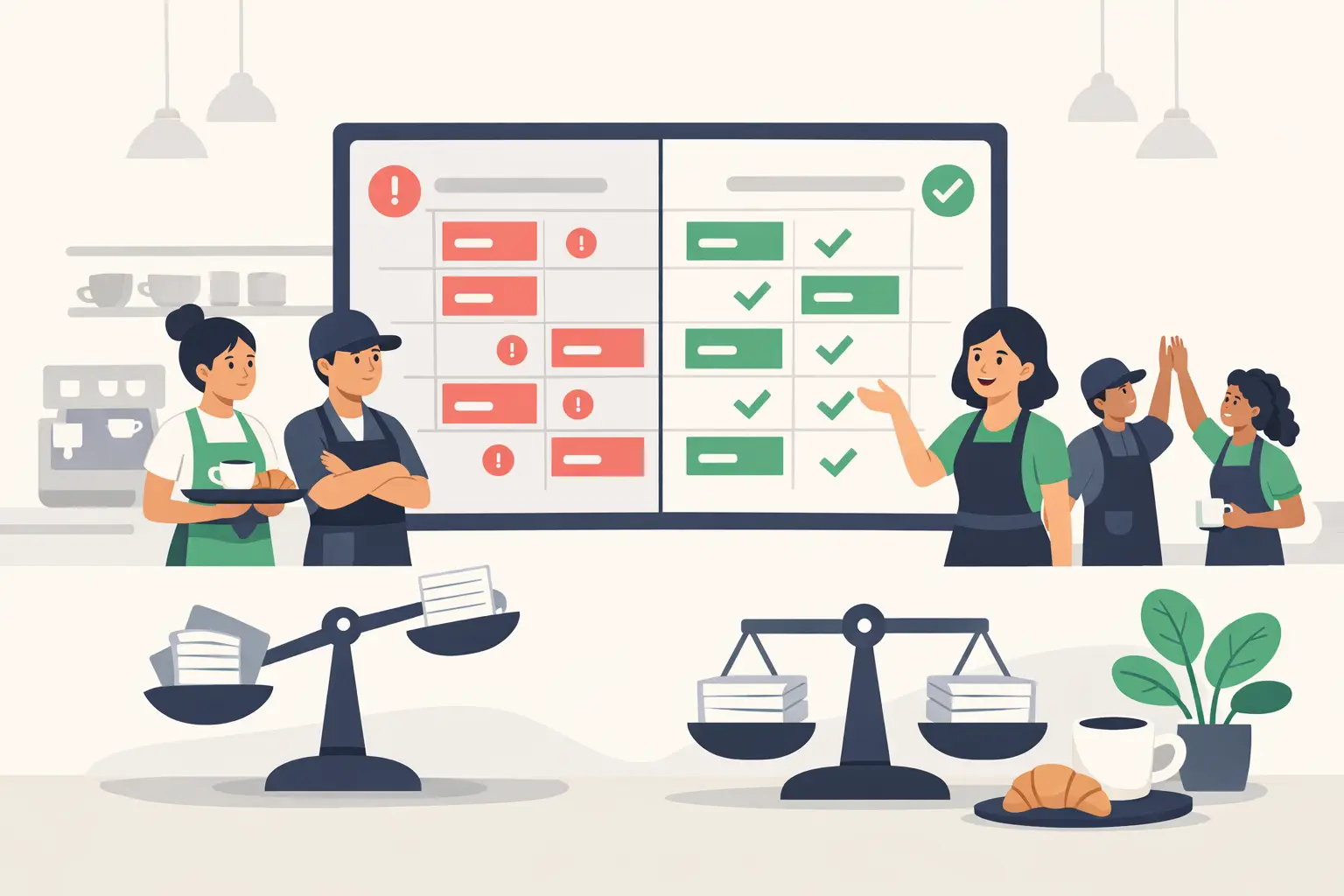
The closing shift is rarely just the closing shift. It is dishes, floors, pastry case cleanup, trash, prep for tomorrow, a last-minute customer, and the quiet expectation that someone will stay late to make it all work. Reducing unfair shifts in cafés starts when managers stop treating that extra labor as invisible.
A café team can survive a busy morning. What wears people down is being the person who always gets the hard close, the rush-hour register, the weekend opening, or the cleanup no one claims. If the same people repeatedly absorb the least desirable work, resentment does not need a staff meeting to grow. It grows in swapped shifts, short tempers, callouts, and eventually turnover.
Fair scheduling is not about making every shift identical. Cafés have peak periods, employee availability, skill differences, and business needs that cannot be ignored. It is about making the trade-offs visible, consistent, and shared.
Why café shifts feel unfair even when the schedule looks equal
A schedule can appear balanced on paper while creating a very uneven experience on the floor. Two employees may each work five shifts, but one works calm weekday opens while the other handles three Saturday rushes and two closes. The hours match. The effort does not.
Then there is the work around the shift. Opening staff may receive the cleanest handoff and leave when their scheduled hours end. Closers may be expected to reconcile a messy station, finish neglected prep, restock milks, clean equipment, and deal with the final wave of guests. Those tasks often expand when the café is understaffed or the day runs behind.
Managers can also unintentionally create a reliability tax. The most dependable barista gets asked to cover absences. The fastest worker gets placed on the busiest bar. The person who never complains gets the close because they will handle it. Reliability deserves recognition, but it should not become a permanent penalty.
The first fix is simple: stop measuring fairness by scheduled hours alone. Measure the weight of the work, too.
Build a fairer shift system around effort
Define what makes a shift harder
Your team already knows which shifts drain people. Ask them directly, then turn the answers into a shared set of factors. A Friday close after a promotional event may carry more effort than a Tuesday mid-shift. An opening shift that includes receiving a delivery may be heavier than a standard open.
Consider workload beyond the clock: customer volume, solo coverage, opening or closing duties, cash handling, heavy cleaning, inventory, training a new hire, and the likelihood of staying late. You do not need a complicated formula. You need a definition people can understand and trust.
A practical approach is to assign effort points. A standard mid-shift might be one point. A rush-hour bar shift, a close, or a weekend open might be two. A particularly demanding shift with closing duties and solo coverage might be three. The exact values matter less than applying them consistently.
This does not mean every employee needs the same total every week. Availability and role requirements make that unrealistic. Instead, look for balance over a reasonable cycle, such as two to four weeks. Someone who takes several high-effort shifts this week should have a lighter mix later, unless they actively prefer the arrangement.
Separate shift coverage from shared labor
One of the fastest ways to create conflict is to bury recurring duties inside a shift assignment. “You are closing” can mean wildly different things depending on who worked before you and what was left behind.
Break recurring work into visible tasks: clean the espresso machine, count drawers, stock cups and lids, take out trash, prep syrups, sanitize the pastry case, complete the order list, and reset the dining area. Assign ownership or rotate these duties rather than assuming the last person standing will do them.
This matters because task completion and shift attendance are not the same thing. A person can show up for every scheduled hour while someone else quietly carries the reset work that keeps the café functional. When that labor is named, it can be distributed.
Use rotation for the shifts nobody races to claim
Not every undesirable shift should rotate mechanically. A strong opener may genuinely prefer early mornings, while a student on your team may only be available for closes. Preferences are useful data, not a problem to eliminate.
But preference should be explicit, voluntary, and revisited. If someone consistently chooses closes because they need the hours, make sure they are not also absorbing every cleaning task and every weekend rush. If someone prefers opens, do not assume that exempts them from less glamorous work forever.
Create a rotation for the hard-to-fill responsibilities: weekend closes, deep-cleaning blocks, holiday shifts, large catering prep, and last-minute coverage. Publish the rotation before building the schedule whenever possible. A rule people can see feels far less personal than a decision that arrives in a text message at 9 p.m.
Make fairness visible before resentment takes over
Most café conflict does not begin with someone refusing to help. It begins with people having different pictures of what is happening. One person thinks they have covered plenty. Another remembers every time they stayed late.
Both may be acting in good faith. Memory is selective, especially when work is stressful. That is why a shared record changes the conversation.
Track who has worked high-effort shifts, who has completed recurring duties, who has covered callouts, and where handoffs regularly fail. Keep the view simple enough for the team to understand. The goal is not to create a leaderboard or shame anyone. The goal is to give resentment fewer places to hide.
A fairness score or effort dashboard can be useful here, provided it is treated as a conversation starter rather than a verdict. If one person’s workload is consistently higher, investigate why. Maybe they requested more hours. Maybe they are being over-relied on. Maybe a role needs clearer training so tasks do not keep flowing to the same capable employee.
Nudge is built for this kind of shared-work reality: recurring tasks, effort-weighted responsibilities, rotation, and a visible fairness picture that helps small teams address imbalance before it becomes personal.
Set rules for swaps, callouts, and staying late
A fair schedule can unravel in a single chaotic week if there are no rules for exceptions. Cafés need flexibility, but flexibility should not mean the same employee always rescues the operation.
Set a clear process for shift swaps. Employees should know where to post an available shift, who approves the swap, and how changes are recorded. A swap is not complete because two people agreed informally. The schedule must reflect it so coverage, labor costs, and workload history remain accurate.
Callouts need the same clarity. Define when employees must notify the manager, what counts as an emergency, and who is responsible for finding coverage. In some cafés, the manager handles all coverage. In others, employees can seek a swap first. Either can work. What fails is an unwritten system where the most responsive person is always pressured to say yes.
Staying late deserves its own rule. If closing tasks regularly exceed the scheduled shift, that is not an employee attitude problem. It is a staffing, workload, or process problem. Track the overages for two weeks. You may find that the close needs another 30 minutes, a better handoff checklist, or a second closer on high-volume days.
Review the pattern, not just the complaint
When someone says the schedule feels unfair, resist the urge to defend each individual decision. Their concern may be about a pattern they cannot fully prove yet.
Review the previous few weeks. Who worked the most closes? Who covered the most absences? Who handled the heaviest shift combinations? Who was assigned recurring duties alongside customer-facing work? Then ask whether the pattern is intentional, sustainable, and understood by the people affected.
Managers should also check their own habits. It is easy to schedule the people you trust in the hardest spots because it protects service quality. But if your best people are always protecting the operation, they eventually pay for it with burnout. Build capability across the team instead. Train more than one person to close well, handle a rush, complete inventory, and resolve a difficult handoff.
Fairness is not sameness, and it is not a promise that every week will feel perfectly balanced. It is a commitment to notice unequal labor, explain necessary trade-offs, and correct patterns before good people decide that caring more has become their job description.