

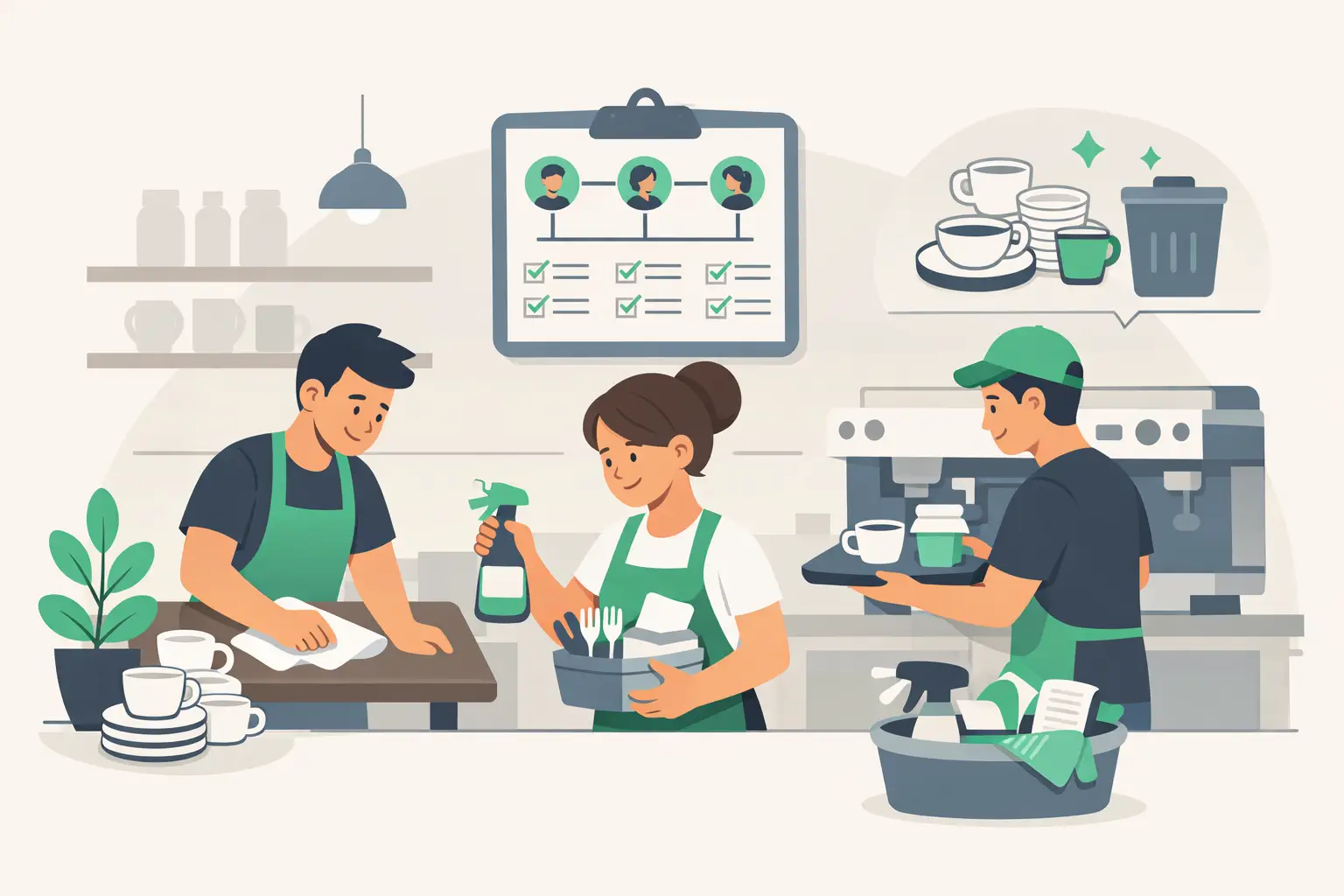
The problem usually shows up at 2:17 p.m. One barista is restocking milks, wiping syrup bottles, and taking out trash while someone else is chatting at the register between orders. Nobody says much in the moment. But by the end of the week, everyone knows who keeps getting stuck with the closing grind. If you want to split sidework among café staff without creating resentment, you need more than a checklist. You need a system people actually trust.
Sidework sounds small until it starts warping morale. Sweeping, stocking lids, cleaning grinders, rotating pastries, sanitizing sinks, refilling ice, washing pitchers, wiping menus, checking bathrooms - none of it feels dramatic on its own. Together, it decides whether your café runs clean, fast, and calm, or whether your strongest people quietly burn out.
Why sidework gets messy so fast
Most cafés do not have a sidework problem because staff are lazy. They have a visibility problem. The visible work gets credit because everyone sees drinks being made and customers being helped. The invisible work gets assigned by habit, proximity, or personality. The reliable person notices the empty cup lids and refills them. The detail-oriented closer catches the sticky fridge handle and scrubs it. The manager sees the shift survive and assumes the load was shared evenly.
That is how unfair systems hide. Not through obvious neglect, but through repetition. The same people start carrying the work that holds the whole place together, and because they are competent, nobody notices until they are irritated, checked out, or gone.
A fair sidework system does two jobs at once. It keeps the café operational, and it makes contribution visible. If only the first part is happening, resentment still has a place to grow.
What a good sidework split actually looks like
If you are trying to split sidework among café staff fairly, equal is not always the same as fair. A four-hour mid shift should not carry the same load as an eight-hour closer. A new hire should not be handed the most technical maintenance tasks on day three. A lead barista may reasonably own more quality-control work, while support staff take on more reset and restock tasks.
Fairness means the effort matches the role, shift length, and pace of service. It also means no one gets permanently trapped in the worst tasks.
That is the part managers often miss. Even when duties are technically assigned, the undesirable jobs tend to cling to the same people. Closing drains, deep-cleaning under the brewer, hauling trash, and bathroom checks all have a way of sticking. A schedule can look organized on paper while still being socially lopsided.
Start with effort, not just task names
Not all sidework takes the same time, energy, or interruption cost. “Restock front fridge” and “clean espresso machine thoroughly” should not live on a chart as if they weigh the same. One takes a few minutes. The other requires timing, attention, and usually gets done while someone is already stretched.
Before assigning anything, group your sidework by actual effort. In most cafés, that means three rough buckets: quick reset tasks, medium routine tasks, and heavier closing or maintenance tasks. You do not need a perfect formula, but you do need a realistic one.
This matters because staff can spot fake fairness instantly. If one person gets five tiny tasks and another gets two unpleasant twenty-minute jobs, they know the split is off. Once trust in the system breaks, people stop believing the manager sees what is really happening.
Build rotations, not fixed ownership
Fixed ownership feels efficient at first. One person always does pastry case cleanup. One person always handles trash. One person always breaks down bar. The problem is that fixed ownership turns invisible labor into identity. Soon the team stops seeing those tasks as shared responsibilities and starts seeing them as that person’s job.
Rotation is better for morale and usually better for training. When staff cycle through opening, mid-shift, and closing sidework, everyone learns how the café actually operates. People gain respect for tasks they used to overlook. Complaints go down because assumptions go down.
There are exceptions. Specialized maintenance, ordering-related checks, or compliance tasks may need consistent ownership. But the more routine the task, the more it benefits from rotation.
Put sidework where shifts really break
Many sidework plans fail because they are written around ideal flow, not real service patterns. You cannot assign ten minutes of focused cleaning to the same person who is expected to cover the register during the afternoon rush. You also cannot dump everything into the last fifteen minutes before close and act surprised when standards slip.
Look at when your café naturally has openings. Maybe there is a reset window after morning rush, a slower stretch before school pickup, or a reliable handoff period between mids and closers. Attach sidework to those real moments.
This is where managers can make a big difference. Sidework should be built into labor design, not treated like extra credit once customer-facing work is done. If the café depends on it, the shift should make room for it.
Make the invisible work visible
A sidework sheet on a clipboard can help, but only if it shows who did what over time. Otherwise, it becomes another box-ticking exercise that tells you tasks got initialed, not whether labor is actually balanced.
The stronger approach is to track recurring tasks across days and weeks. Who handled close-down cleaning three times this week? Who keeps absorbing mid-shift restocking because they notice shortages first? Who gets the low-friction wipe-down tasks while someone else keeps doing the gritty cleanup?
When contribution becomes visible, resentment loses its hiding place. That is the real goal. Not surveillance, but clarity. People are far more willing to do their share when they believe the system can tell the difference between shared effort and silent overfunctioning.
This is also where a fairness-first tool can help. Nudge, for example, is built around shared labor visibility rather than simple task completion. For small café teams, that matters because the issue is rarely whether tasks exist. It is whether the load is being carried evenly enough to keep the team stable.
How to split sidework among café staff without pushback
The fastest way to create resistance is to announce a new system that feels punitive. If staff think sidework tracking is just a way to catch mistakes, they will treat it like management theater.
Frame it correctly. The point is not to micromanage mop buckets. The point is to stop the same people from carrying the café in ways no one acknowledges.
Keep the rollout simple. Show the team the full sidework list. Explain how tasks were weighted. Be honest about what is flexible and what is not. Ask where the current split feels uneven. You will probably hear useful things immediately, especially from staff who have been doing the invisible maintenance work for months.
Then test the rotation for two weeks and review it. Some assignments will prove unrealistic. Some tasks will need to move to different times of day. That is normal. Fair systems get better through adjustment, not through pretending the first draft was perfect.
Common mistakes that make fair plans fail
One common mistake is treating all staff as interchangeable when their shifts are not. Another is assigning sidework by personality - giving detail-heavy tasks to the neat person and urgency tasks to the fast person until those strengths become punishment.
Managers also underestimate handoff problems. If opening staff leave the sinks cluttered, mids inherit cleanup that was never on their list. If closers are expected to finish what the afternoon team skipped, the closing chart will always look heavier than it should.
The fix is accountability at transition points. Sidework should not just belong to individuals. It should belong to the shift layer too. Openers reset for mids. Mids set closers up to finish well. When those handoffs are explicit, blame drops and standards rise.
Another mistake is letting sidework become negotiable only when the café is busy. Of course service comes first in a rush. But if sidework gets abandoned every time the day gets hard, the burden simply rolls downhill. Usually onto the most dependable person on the next shift.
The goal is not perfection. It is trust.
No café will split sidework among café staff in a way that feels perfectly equal every single day. Someone will call out. A rush will hit late. One shift will inherit more mess than expected. Fairness is not sameness in every moment. It is the confidence that over time, the load evens out and everyone can see that it does.
That confidence changes the culture. Staff stop keeping private scorecards. Managers spend less time resolving low-grade tension. The team becomes more willing to help each other because helping no longer feels like volunteering for permanent extra work.
A clean café matters. A stocked café matters. But the real win is quieter than that. It is when your team no longer has to wonder who is carrying the place behind the scenes.